

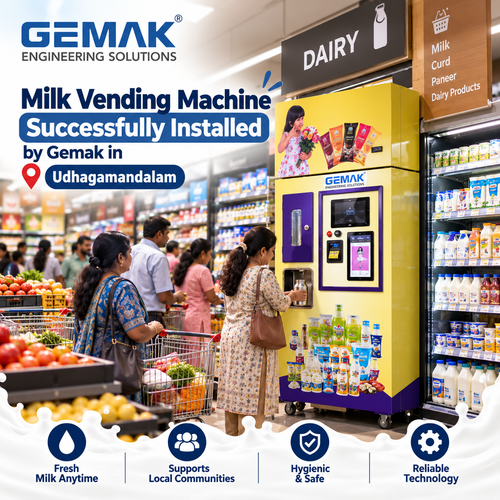
Milk distribution is becoming more automated as dairy organisations seek convenient, efficient ways to serve consumers. A milk vending machine offers a practical alternative to conventional milk retailing by letting customers purchase and dispense the exact quantity of milk they need through an automated system.
As part of this shift toward dairy automation, Gemak has successfully installed an automatic milk vending machine near the farmer’s market at Charring Cross in Udhagamandalam, Nilgiris, Tamil Nadu. The machine was inaugurated by District Collector Lakshmi Bhavya Tanneeru and was introduced with the objective of making milk dispensing more convenient while helping address plastic waste associated with conventional milk sachets.
According to the supplied news report, the milk vending station was installed at an approximate cost of ₹7 lakh. The system supports multiple payment options, including cash, prepaid cards, and digital payment gateways, and can dispense the corresponding quantity of milk based on the payment made. The reported minimum purchase value is ₹10. Pasted text
The successful installation represents a real-world application of automated milk dispensing technology and demonstrates how Gemak is contributing to the adoption of modern solutions for milk distribution.
What Is a Milk Vending Machine?
A milk vending machine is an automated milk dispensing system that allows consumers to purchase a required quantity of milk without relying entirely on conventional counter-based selling.
Instead of purchasing a fixed-size milk sachet, a customer can use the vending system to select the required quantity or make a payment according to the machine’s operating process. The system then dispenses the corresponding quantity of milk.
For dairy businesses and milk distribution points, this type of automation can help simplify the purchasing process and reduce the amount of manual intervention involved in individual transactions.
The technology can be particularly useful for farmer markets, dairy cooperatives, milk retailers, farms, and other locations where milk is distributed directly to consumers.
How Does an Automatic Milk Vending Machine Work?
The basic concept behind an automatic milk vending machine is straightforward.
Milk is supplied to the appropriate storage or cooling arrangement connected to the dispensing system. A customer then approaches the machine and selects the required quantity or payment value.
Depending on the machine configuration, the customer can complete the transaction using an available payment method. The system then dispenses the corresponding quantity of milk, allowing the customer to collect it in a suitable container.
This automated process brings several activities together at one point, including quantity selection, payment, and milk dispensing.
The exact operation and technical configuration can vary according to the requirements of the installation.
Benefits of a Milk Vending Machine
The successful Gemak installation in Udhagamandalam highlights several potential advantages of automated milk dispensing.
Convenient Milk Purchasing
Customers can access milk through an automated dispensing point rather than depending exclusively on traditional counter-based transactions.
Controlled Milk Dispensing
The system is designed to dispense milk according to the selected or paid quantity, providing a more controlled purchasing process.
Multiple Payment Options
The Udhagamandalam installation supports cash, prepaid cards and digital payment gateways, giving consumers different ways to complete their purchases. Pasted text
Reduced Packaging Dependence
One of the key objectives reported for the Udhagamandalam project was reducing plastic waste associated with milk sachets. A vending model can support this objective by allowing customers to bring appropriate containers for milk collection.
Automated Retail Experience
Automation can reduce manual intervention during the purchasing process and create a more structured milk retailing experience.
A Real-World Example of Dairy Automation
The Udhagamandalam installation is more than just an example of vending technology; it demonstrates how automated milk dispensing can be implemented in an actual milk distribution environment.
The machine installed by Gemak combines the concept of automated dispensing with a consumer-facing retail application. Its installation at a farmer’s market location also places the technology closer to consumers who regularly purchase milk.
The project therefore demonstrates a practical approach to bringing dairy automation into everyday milk distribution.
Why Automated Milk Dispensing Is Becoming Important
Traditional milk distribution often depends on packaged milk products and manual retail transactions. Automated dispensing introduces another model in which milk can be distributed through a dedicated dispensing system.
For consumers, the attraction is convenience and quantity flexibility. For dairy organizations and milk retailers, automation can help organize dispensing and payment at the point of sale.
There is also an environmental consideration. The Udhagamandalam project was specifically associated with the need to reduce plastic waste from milk sachets. The supplied report notes that Aavin sells more than 60 lakh milk sachets every day across Tamil Nadu, highlighting the scale of packaging involved in milk distribution. Pasted text
While a milk vending machine alone cannot eliminate packaging waste, a properly implemented vending model can contribute to reducing the need for individual milk sachets.
Gemak Role in Milk Vending Automation
The successful installation in Udhagamandalam demonstrates Gemak involvement in providing and installing automated milk vending equipment for a real milk distribution application.
Rather than being only a theoretical concept, this project represents a completed installation where automated milk dispensing has been introduced for public use.
For organisations exploring dairy automation, such real-world installations demonstrate how milk vending technology can be adapted to specific distribution environments and consumer requirements.
The Udhagamandalam project is therefore a valuable example of how engineering expertise and automation can come together to support modern milk distribution.
Frequently Asked Questions About Milk Vending Machines
What is a milk vending machine?
A milk vending machine is an automated system that allows consumers to purchase and dispense a selected quantity of milk. It can combine milk dispensing with payment and quantity-control functions.
Where was the Gemak milk vending machine installed?
Gemak successfully installed the automatic milk vending machine near the farmer’s market at Charring Cross in Udhagamandalam, Nilgiris, Tamil Nadu.
What payment methods are available?
The reported Udhagamandalam machine supports cash, prepaid cards and digital payment gateways. Pasted text
What was the reported cost of the Udhagamandalam installation?
The supplied news report states that the milk vending station was installed at an approximate cost of ₹7 lakh. Pasted text
Can a milk vending machine reduce plastic waste?
A milk vending model can potentially reduce dependence on individual milk sachets when customers use suitable reusable containers. The Udhagamandalam project was specifically launched with reducing plastic waste from milk sachets as one of its objectives.
Who can use milk vending machines?
Milk vending systems can be suitable for dairy organizations, cooperatives, farmer markets, milk retailers, farms, and other locations where milk needs to be dispensed directly to consumers.
Conclusion
The successful installation of the milk vending machine by Gemak in Udhagamandalam demonstrates how automated milk dispensing can be implemented in a real-world milk distribution environment.
With automated quantity dispensing, multiple payment options, and a model that can support reduced dependence on individual milk sachets, milk vending technology offers an alternative approach to traditional milk retailing.
As dairy businesses continue to explore automation, successful projects such as the Udhagamandalam installation show how technology can make milk distribution more convenient, organised and adaptable to changing consumer needs.