

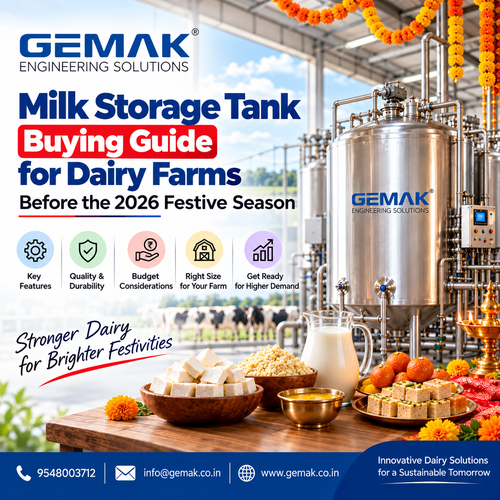
Think about a typical festival at home. A glass of milk in the morning, homemade sweets for guests, kheer after dinner, or a fresh cup of chai shared with family—all of these simple moments depend on a reliable milk supply.
During major festive periods, demand for milk and dairy products can increase across households, sweet shops, restaurants, and food businesses. Dairy farms may also experience higher collection volumes. When more milk needs to be handled within a limited period, proper storage becomes increasingly important.
A suitable milk storage tank helps dairy businesses manage collected milk in a hygienic and organised way before it moves to the next stage of processing, transportation, or distribution. For a dairy farmer, this is not simply about storing milk. It is about protecting something that eventually becomes part of another family’s celebration.
What Is a Milk Storage Tank?
A Milk Storage Tank is dairy equipment designed to hold milk safely and hygienically before further processing, transportation, or use.
Depending on the application, a tank may be designed with features related to temperature management, insulation, cleaning, mixing, and controlled milk handling.
For dairy farms, milk collection centres, cooperatives, and processing facilities, selecting the right tank requires more than simply choosing a capacity. The tank should match the business’s milk volume, operating conditions, hygiene requirements, available space, and future needs.
How Does a Milk Storage Tank Connect to the Festive Season?
The connection may not be obvious at first.
When families prepare gulab jamun, rasmalai, peda, kheer, kalakand, paneer, or traditional milk-based sweets, the milk used in those products has already passed through several stages of handling.
That journey often starts at the dairy farm.
A farmer collects milk from the herd. The milk then needs to be handled properly before it reaches a collection centre, processor, sweet manufacturer, or other buyer. During the festive season, when businesses may need to handle higher volumes, efficient storage becomes even more important.
This is where a properly selected Milk Storage Tank becomes part of the bigger picture.
The tank itself may never be seen by a family sitting together during Diwali or another festival. But the milk it helps store and handle can eventually become part of the sweets served at that family’s celebration.
That is the human side of dairy storage.
What Should You Consider Before Buying a Milk Storage Tank?
Choosing a tank before the 2026 festive season should start with understanding your actual dairy operation.
1. Choose the Right Capacity
Capacity is one of the first things a dairy business should evaluate.
Start by looking at your:
- Average daily milk collection
- Expected peak collection
- Seasonal demand
- Collection frequency
- Future business expansion
- Available storage and installation space
For example, imagine a dairy farm normally handles around 1,000 litres of milk per day but expects collection to rise during the festive season. Buying equipment based only on the normal volume could create unnecessary pressure when milk collection increases.
At the same time, choosing an excessively large tank without considering actual operations can increase investment and space requirements.
The goal is to select capacity based on current requirements, peak conditions, and realistic future growth.
2. Check the Material and Construction
Milk comes into direct contact with the tank’s internal surfaces, so hygiene should be a major consideration.
Stainless steel is widely used in dairy applications because it offers durability, corrosion resistance, and a surface suitable for hygienic milk handling when properly designed and maintained.
When evaluating a tank, ask the manufacturer about:
- Material specification
- Internal surface finish
- Construction quality
- Weld quality
- Cleaning accessibility
- Long-term durability
Do not focus only on appearance. The construction and hygienic design matter much more for long-term dairy operations.
3. Consider Temperature Management
Milk quality can be affected by how it is handled after collection.
Depending on the dairy setup, temperature management may involve cooling equipment, insulation, monitoring systems, or integration with other dairy equipment.
Before purchasing a tank, understand how it will fit into your existing milk handling process.
Ask:
Will the tank work effectively with my current cooling and milk handling system?
This simple question can help prevent compatibility problems later.
4. Don’t Overlook Cleaning and Hygiene
During the festive season, dairy operations can become extremely busy. That makes efficient cleaning even more important. Look for a tank design that supports practical cleaning and maintenance.
Ask about:
- Internal surface design
- Drainage
- Accessibility
- Cleaning procedures
- CIP compatibility, where applicable
- Inspection requirements
A tank that is difficult to clean can create unnecessary work for the dairy team.
5. Think Beyond the Purchase Price
The cheapest tank is not automatically the most suitable option.
A dairy business should also consider:
- Maintenance requirements
- Spare parts availability
- Installation support
- Warranty
- Technical assistance
- Service network
- Long-term operating requirements
A slightly different initial investment can have a meaningful impact on the equipment’s overall value over its working life.
A Simple Example Before the 2026 Festive Season
Consider a dairy farmer who normally collects between 800 and 1,000 litres of milk each day. As the festive season approaches, a nearby sweet manufacturer starts requesting additional milk. The farmer expects collection volumes to rise but has limited storage space at the farm.
Instead of purchasing equipment based only on today’s volume, the farmer should review the expected peak requirement, future growth, available space, cleaning process, and compatibility with the existing cooling system.
This approach makes the purchase more thoughtful.
The objective isn’t simply to have a bigger tank. It is to have the right storage solution for the way the dairy actually operates.
Common Mistakes to Avoid When Buying a Milk Storage Tank
Before placing an order, dairy businesses should avoid some common mistakes:
- Choosing capacity based only on current milk volume
- Ignoring seasonal changes in milk collection
- Focusing only on the initial purchase price
- Overlooking cleaning and hygiene requirements
- Not checking available installation space
- Ignoring future business expansion
- Not asking about after-sales service and spare parts
- Buying equipment without checking compatibility with existing systems
A good buying decision begins with questions—not just a quotation.
Why Choose an Experienced Dairy Equipment Manufacturer?
Dairy equipment is part of a larger production system. The right manufacturer should understand that every dairy business has different requirements.
Before making a purchase, discuss your milk volume, operating process, space, cleaning practices, and plans with the manufacturer.
An experienced dairy equipment company such as Gemak can be considered as part of the evaluation process when exploring milk storage solutions for dairy applications. Buyers should still assess the specific product configuration, technical specifications, service support, and suitability for their own operation.
The important point is to choose equipment based on your dairy’s actual requirements, rather than selecting a tank simply because it looks suitable on paper.
Your 2026 Festive Season Milk Storage Checklist
Before buying a Milk Storage Tank, ask yourself:
- What is my average daily milk volume?
- What could my peak festive-season volume be?
- Will my business expand in the coming years?
- What tank capacity fits my operation?
- What material and construction does the tank use?
- How will it fit into my existing cooling system?
- How easy is it to clean?
- What maintenance will be required?
- Is installation support available?
- Are spare parts and technical support accessible?
- Does the manufacturer understand my dairy application?
Answering these questions before purchasing can help reduce the chances of making an expensive decision that doesn’t fit your operation.
Frequently Asked Questions
What is a Milk Storage Tank used for?
A milk storage tank is used to hold milk hygienically before it moves to processing, transportation, or another stage of dairy handling. Its capacity and features should be selected according to the dairy operation’s milk volume and storage requirements.
What size Milk Storage Tank does a dairy farm need?
The appropriate size depends on daily milk collection, peak volume, collection frequency, future expansion, and the farm’s operating setup. Farmers should evaluate both current and expected future requirements instead of choosing capacity based only on today’s production.
Which material is commonly used for milk storage tanks?
Stainless steel is commonly used in dairy applications because of its durability, corrosion resistance, and suitability for hygienic handling when properly designed, cleaned, and maintained.
Why is proper milk storage important during festivals?
Festive periods can bring increased demand for milk and milk-based products such as sweets, paneer, and desserts. Proper storage helps dairy businesses manage milk efficiently as collection and supply requirements change.
What should I check before buying a Milk Storage Tank?
Check capacity, construction material, hygienic design, cleaning requirements, temperature management, installation space, maintenance, warranty, spare parts, technical support, and compatibility with your existing dairy equipment.
How can dairy farmers prepare their milk storage system for the festive season?
Farmers should review expected milk volumes, inspect existing equipment, plan cleaning and maintenance, assess storage capacity, and identify potential seasonal increases before the festive rush begins.
Final Thoughts
Festivals are built around moments that feel simple—sharing sweets with family, serving a warm glass of milk, preparing traditional desserts, or welcoming guests home.
But behind those moments is a long dairy supply chain, and farmers are an important part of it. For dairy businesses, preparing for the 2026 festive season means preparing for changing milk volumes and greater operational pressure. The right Milk Storage Tank can become an important part of that preparation when its capacity, hygiene, construction, cleaning, and long-term requirements are properly evaluated.
Because sometimes, good dairy equipment is not just about storing milk.
It is about helping that milk complete its journey from the farm to someone’s festive table.