

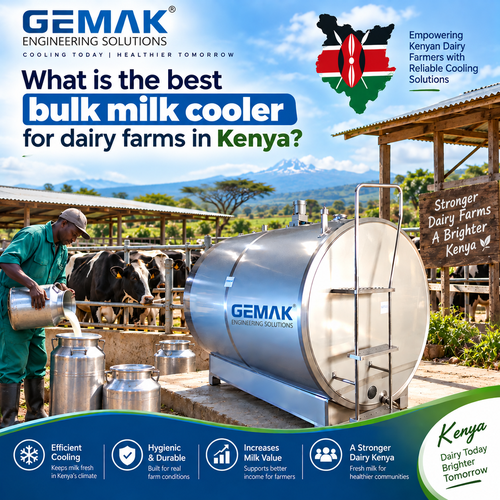
Fresh milk needs careful handling from the moment it leaves the cow. For dairy farmers in Kenya, a reliable bulk milk cooler can help cool freshly collected milk and maintain suitable conditions until it is collected, transported, or processed.
Kenya’s dairy sector includes smallholder farms, commercial farms, cooperatives, and milk collection centres. Because milk may be collected from different farms and transported over varying distances, choosing suitable milk cooling equipment is an important part of efficient dairy management.
What is a bulk milk cooler?
A bulk milk cooler is refrigerated dairy equipment designed to cool freshly collected milk and keep it chilled until transportation or processing. It generally consists of a stainless-steel tank, refrigeration system, insulation, temperature controls, and an agitator.
The purpose is straightforward: remove heat from freshly collected milk and maintain controlled conditions during storage.
A milk cooling tank is particularly useful when milk is not transported immediately after milking. Instead of allowing freshly collected milk to remain exposed to surrounding temperatures, the farmer or collection centre can place it inside a refrigerated tank.
The exact cooling performance depends on factors such as the quantity of milk, starting milk temperature, refrigeration capacity, tank design, insulation, and surrounding conditions.
Why is milk cooling important for dairy farms?
Milk quality can be affected by how it is handled after milking. Kenya’s dairy industry includes many smallholder farmers who supply milk to cooperatives and collection centres, making proper handling important throughout the supply chain.
Weather is another consideration. Kenya experiences considerable variations in temperature, rainfall, altitude, and local climate. Warmer conditions can increase the importance of having appropriate cooling arrangements after milk collection.
A bulk milk cooling tank can help provide controlled storage between milking and collection.
For example, a farmer in a warmer area may need to manage milk carefully before the collection vehicle arrives. Similarly, a cooperative receiving milk from several farms needs adequate cooling capacity to manage the combined volume.
Cooling is therefore not only about the equipment itself. It is part of a broader milk-handling process that includes hygienic milking, clean containers, timely collection, transportation, and proper storage.
How does a bulk milk cooler work?
The working principle of a bulk milk cooler is based on refrigeration.
Fresh milk enters the tank after milking or collection. The refrigeration system removes heat from the milk through the cooling surface. Insulation helps reduce heat transfer from the surrounding environment.
An agitator gently circulates the milk to help maintain a more uniform temperature throughout the tank.
The process can be summarised as:
- Milk is collected after milking.
- It is transferred into the cooling tank.
- The refrigeration system removes heat.
- The agitator helps distribute the cooling effect.
- Temperature controls monitor the system.
- The milk remains chilled until collection or processing.
The actual cooling rate will depend on the equipment specifications and operating conditions. Buyers should therefore check the manufacturer’s technical information instead of assuming that every tank will perform identically.
What factors should you consider when choosing a cooler?
Choosing a dairy milk cooler requires more than comparing prices. The equipment should suit the farm’s milk volume, operating environment, infrastructure, and future requirements.
Capacity
Tank capacity should match the quantity of milk that needs to be cooled. A small dairy farm will have different requirements from a cooperative collecting milk from many farmers.
Consider:
- Average daily milk production
- Peak production
- Number of milk suppliers
- Collection frequency
- Expected future growth
Cooling performance
The refrigeration system should be appropriately matched to the tank size and intended application.
Ask the supplier about cooling performance, refrigeration capacity, temperature control, and operating requirements before making a decision.
Stainless-steel construction
A quality bulk milk tank should have suitable food-grade stainless-steel milk-contact surfaces.
The internal finish should support effective cleaning and hygiene. This is especially important because milk residues can create sanitation problems if equipment is not cleaned properly.
Insulation
Good insulation helps reduce heat transfer between the cooled milk and the surrounding environment. This can support more consistent cooling and efficient operation.
Agitation
The agitation system helps circulate milk within the tank. Buyers should ensure that the agitator is appropriately designed for the tank’s capacity and intended operation.
Cleaning and maintenance
A cooler is a long-term investment, so cleaning and maintenance should be considered before purchase.
Ask about cleaning procedures, servicing requirements, spare parts, installation, and technical support.
How do you choose the right capacity?
Selecting the right capacity is one of the most important decisions when purchasing a milk chilling tank.
Do not select a tank simply because it has the largest available capacity. Instead, consider how much milk you actually collect and how that volume may change in the future.
Example 1: Small dairy farm
Imagine a smallholder farm producing a few hundred litres of milk per day. The farmer should consider how much milk is available during each milking session, when the milk is collected, and whether production is expected to increase.
A properly sized farm milk cooler can be more practical than investing in significantly more capacity than the farm needs.
Example 2: Dairy cooperative
A cooperative receiving milk from multiple smallholder farmers has different requirements. Its tank may need to handle milk arriving at different times throughout the day.
The cooperative should consider peak collection volume, supplier numbers, transportation schedules, electricity availability, and future expansion.
Which type of cooler is suitable for different applications?
Different dairy businesses can require different configurations.
A horizontal cooling tank may be suitable where floor space and easy access for cleaning and operation are important considerations.
A vertical system may be considered where available floor space is limited and a different equipment layout is preferred.
Direct-expansion systems can provide efficient refrigeration by transferring heat from the milk through the cooling system. Other configurations may use different approaches depending on the operating requirements.
For buyers in Kenya, the choice should also consider local electricity availability, installation conditions, maintenance support, and the environment where the equipment will operate.
How can farmers improve milk handling?
A cooling tank works best when it is part of a proper milk-handling routine.
Farmers and collection centres should pay attention to:
- Clean milking equipment
- Hygienic milk collection
- Timely transfer of milk to the cooler
- Regular cleaning and sanitation
- Temperature monitoring
- Proper maintenance
- Reliable transportation arrangements
Kenya’s climate varies significantly between regions, so dairy operators should consider their local conditions when developing a milk-handling process.
In areas where electricity reliability is a concern, farmers and cooperatives can also investigate alternative or energy-conscious cooling solutions that suit their specific location and operating requirements.
Why consider Gemak?
When purchasing dairy equipment in Kenya, the supplier’s technical capability and after-sales support are important considerations alongside the equipment itself.
Gemak can be considered when evaluating milk cooling solutions for dairy farms, cooperatives, and milk collection operations.
Before choosing a system, buyers should discuss milk volume, cooling requirements, available power, installation space, cleaning procedures, maintenance, spare parts, and future expansion with the supplier.
The objective should be to select equipment that fits the actual operation rather than choosing a system based solely on price or tank size.
What is the best bulk milk cooler for dairy farms in Kenya?
The best bulk milk cooler is the one that fits the specific requirements of the dairy operation. Capacity, cooling performance, stainless-steel construction, insulation, temperature control, agitation, energy requirements, cleaning, maintenance, and technical support should all be considered.
For a smallholder farmer, the priorities may be different from those of a large cooperative or collection centre. Kenya’s varied climate and dairy-farming conditions make it especially important to evaluate the actual location and milk-handling process before purchasing equipment.
A well-selected milk storage and cooling system can support better milk handling from the farm through collection and transportation.
Frequently Asked Questions
What is a bulk milk cooler?
A bulk milk cooler is refrigerated equipment used to cool freshly collected milk and maintain it under controlled chilled conditions before transportation or processing. It generally includes a stainless-steel tank, refrigeration system, insulation, temperature controls, and an agitator.
What size bulk milk cooler do I need?
The required capacity depends on daily milk production, peak volumes, collection frequency, number of milk suppliers, storage requirements, and expected growth. The tank should be selected according to the quantity of milk that needs to be cooled at one time.
Why is a bulk milk cooler important?
A bulk milk cooler provides controlled chilled storage for freshly collected milk before transportation or processing. Proper cooling is one part of maintaining milk quality alongside hygienic milking, clean equipment, appropriate storage, and timely transportation.
What should I look for in milk cooling equipment?
Look at tank capacity, refrigeration performance, stainless-steel construction, insulation, temperature controls, agitation, cleaning requirements, energy consumption, maintenance, spare-parts availability, installation requirements, and technical support.
Can a milk cooler be used at a collection center?
Yes. Milk cooling systems can be used at collection centres where milk from several farms is consolidated before transportation or processing. The required capacity and configuration depend on the centre’s milk volume, collection schedule, infrastructure, and future growth.