

Introduction: Why Is Maintaining Milk Quality a Challenge for Dairy Businesses?
For dairy farms and milk collection centres, maintaining milk quality starts immediately after milking. Delays in chilling, poor storage conditions, and inadequate cleaning can increase bacterial growth and spoil milk. These problems affect product quality, processing efficiency and business profitability.
For mid-sized dairy businesses handling increasing milk volumes, traditional storage methods may not provide sufficient temperature control. A Bulk Milk Cooler (BMC) helps address this challenge by rapidly cooling freshly collected milk and maintaining the required storage temperature.
Investing in the right BMC milk machine is therefore an important operational decision. It helps dairy businesses manage milk collection, reduce avoidable quality losses, and prepare raw milk for further processing.
The Short Answer: Why Is a BMC Milk Machine Important?
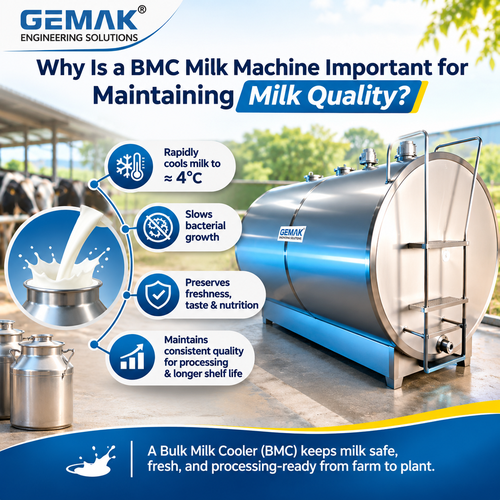
A BMC milk machine is important because it rapidly cools freshly collected raw milk and maintains a controlled temperature during temporary storage. This slows bacterial multiplication, helps preserve milk quality, and reduces spoilage risks before transportation or pasteurisation. It also supports hygienic milk handling and more consistent dairy operations.
Why Does a Bulk Milk Cooler Matter for Mid-Sized Dairy Companies?
Mid-sized dairy businesses often operate between small collection centres and large processing facilities. They must manage milk from multiple suppliers while maintaining consistent quality.
Without appropriate cooling infrastructure, several operational problems can develop.
- Delayed milk cooling: Milk collected from different farms may reach the collection centre at different times. Delayed chilling increases the risk of bacterial multiplication.
- Quality inconsistency: Milk from different collection points can have varying quality levels. Poor temperature management makes consistent processing more difficult.
- Increased wastage: Milk that does not meet the required quality parameters may be rejected during processing.
- Operational pressure: Manual handling and inadequate storage facilities create additional work for collection-centre operators.
According to the National Dairy Development Board (NDDB), raw milk requires immediate chilling because it remains in good condition at normal temperatures for only a few hours. NDDB also explains that bulk milk coolers generally store milk at 4°C or colder.
National Dairy Development Board
For a growing dairy business, controlling these risks is essential for maintaining reliable milk procurement and processing operations.
How Does a Bulk Milk Cooler Work to Maintain Milk Quality?
A bulk milk cooler uses a refrigeration system to remove heat from freshly collected milk. The milk is stored inside a stainless-steel tank, while an agitator helps maintain uniform temperature throughout the stored volume.
The process generally involves four stages:
- Milk collection: Fresh milk is collected and transferred into the BMC.
- Rapid cooling: The refrigeration system reduces the milk temperature.
- Temperature maintenance: The cooling system maintains the required temperature during storage.
- Milk dispatch: Chilled milk is transferred to a dairy processing facility for further treatment.
FSSAI’s 2019 Milk and Milk Products Guidance Document recommends suitable chilling technology at collection centres to cool milk to 5°C or below. It also highlights hygienic equipment, cleaning facilities, and proper transportation.
FSSAI Mail
Which Milk Cooling Method Is Better for Dairy Businesses?
The right approach depends on milk volume, collection frequency, transportation distance and available infrastructure.
| Cooling approach | How it works | Business consideration |
| Traditional milk cans | Milk is collected and transported in containers. | Requires quick transportation and provides limited cooling control |
| Bulk Milk Cooler | Milk is chilled and temporarily stored in a refrigerated tank. | Supports controlled cooling and bulk collection |
| Refrigerated milk storage | Chilled milk is held under controlled conditions | Suitable for maintaining temperature before further processing |
An honest trade-off: A BMC requires initial investment, electricity, cleaning and preventive maintenance. However, relying on uncooled storage can increase spoilage risks and transportation pressure. Businesses should compare the total operating cost against their actual milk handling requirements.
The 4C Milk Quality Rule: A Practical Framework
A useful operational rule for dairy businesses is the 4C Milk Quality Rule:
- Collect: Receive milk promptly after milking.
- Cool: Reduce the milk temperature quickly.
- Control: Monitor temperature and maintain consistent agitation.
- Clean: Sanitise the equipment between collection cycles.
This framework connects equipment selection with daily operational practices. A BMC alone cannot guarantee milk quality. The collection process, equipment hygiene, and temperature monitoring must work together.
How Should You Choose the Right Bulk Milk Cooler? A Step-by-Step Roadmap
Selecting a BMC requires more than comparing tank prices. Dairy businesses should evaluate their current requirements and future production plans.
Step 1: Calculate daily milk collection
Identify the average quantity of milk collected daily. Also consider seasonal changes and expected increases in procurement.
Step 2: Determine the required capacity.
Select a BMC that accommodates collection volumes without unnecessary oversizing. Consider whether milk arrives in one or multiple collection cycles.
Step 3: Evaluate cooling performance
Ask manufacturers about cooling time, refrigeration capacity, temperature controls and performance under local operating conditions.
Step 4: Check construction and hygiene
Evaluate stainless-steel construction, internal surface finishing, drainage, agitator design, and cleaning accessibility.
Step 5: Review electricity and maintenance requirements.
Understand power consumption, compressor requirements, service availability, and spare-part support. These factors influence long-term operating costs.
Step 6: Plan installation and expansion
Check available floor space, electrical infrastructure, drainage and transportation access. Consider whether additional storage or processing equipment may be needed later.
Step 7: Verify operating procedures
Establish temperature monitoring, cleaning schedules, equipment inspections and milk quality testing procedures before commissioning.
NDDB’s Bulk Milk Cooling Units: Commissioning, Operation and Maintenance guidance also emphasises equipment cleaning, correct operating settings and preventive maintenance.
Dairy Knowledge
What Common Mistakes Should You Avoid When Buying a BMC Milk Machine?
Even a technically suitable milk cooling machine can underperform if businesses overlook operational requirements.
Avoid these common mistakes:
- Choosing capacity only by price: Select capacity according to actual and projected milk collection.
- Ignoring cleaning requirements: Milk residues can create contamination risks. Establish proper cleaning procedures.
- Overlooking temperature monitoring: Regularly check and record milk temperature.
- Ignoring electricity requirements: Assess power availability and operating expenses before installation.
- Skipping maintenance: Inspect refrigeration components, agitators and controls regularly.
The key is to evaluate the complete cooling operation rather than purchasing equipment based on capacity alone.
How Does Gemak Engineering Solutions Support Dairy Businesses?
Gemak Engineering Solutions manufactures dairy processing and milk storage equipment in Ghaziabad, Delhi NCR, India. Its product portfolio includes bulk milk coolers, milk storage tanks and dairy processing equipment.
Its relevant equipment includes:
- Bulk Milk Cooler: Horizontal enclosed models with capacities from 1,000 to 10,000 litres and vertical models from 100 to 2,000 litres.
- Milk Pasteuriser: Fully automatic HTST pasteuriser options with capacities listed from 1,000 to 20,000 LPH.
- Milk Tank: Horizontal and vertical storage solutions designed for different dairy storage requirements.
For dairy project planning, a practical Discover-Design-Build-Scale approach can help:
- Discover: Understand milk collection and processing requirements.
- Design: Plan equipment capacity and plant layout.
- Build: Develop the required dairy equipment solution.
- Scale: Plan additional capacity as operational requirements grow.
This approach helps businesses connect equipment selection with their long-term processing objectives.
Frequently Asked Questions About Bulk Milk Coolers
1. What temperature should a bulk milk cooler maintain?
Milk is generally chilled to around 4°C. NDDB describes storage at 4°C or colder, while FSSAI guidance recommends appropriate chilling to 5°C or below at collection centres.
National Dairy Development Board
2. Does a bulk milk cooler increase milk shelf life?
Yes, rapid chilling slows bacterial multiplication and helps preserve raw milk quality. However, actual storage life depends on initial milk quality, hygiene, temperature consistency and handling practices.
3. Which bulk milk cooler capacity is suitable for a dairy farm?
Capacity depends on daily milk production, collection frequency and future expansion plans. Smaller operations may consider vertical BMC models, while higher-volume operations may require larger horizontal systems.
Conclusion: Invest in the Right BMC Milk Machine for Better Milk Quality
Maintaining milk quality requires timely chilling, hygienic storage, and consistent temperature monitoring. A suitable bulk milk cooler helps dairy businesses manage these requirements while supporting efficient collection and processing.
Looking to upgrade your dairy infrastructure? Connect with Gemak Engineering Solutions to explore suitable BMC, milk pasteuriser, and milk storage tank solutions for your operational needs.