

India’s dairy industry is undergoing one of its biggest transformations in decades. From village milk collection centers to large-scale automated dairy plants, technology is rapidly changing how milk is stored, processed, transported, and delivered to consumers.
Today, dairy businesses are no longer focused only on increasing milk production. The real challenge lies in maintaining milk quality, reducing spoilage, improving efficiency, and meeting strict hygiene standards. This growing demand for operational excellence is driving investments in Modern Dairy Equipment across India.
According to official data from the Government of India, India produced nearly 239.30 million tonnes of milk during 2023–24, making it the largest milk producer in the world. This massive dairy network supports the livelihoods of millions of farmers and rural families across the country while contributing almost one-fourth of global milk production.
What is Modern Dairy Equipment?
Modern dairy equipment refers to advanced machinery and automated systems used for milk collection, chilling, storage, processing, packaging, cleaning, and quality management. These systems are designed to improve hygiene, speed, consistency, and operational efficiency across the complete dairy value chain.
Unlike traditional dairy systems, modern equipment is designed to improve:
- Milk hygiene
- Processing speed
- Product consistency
- Energy efficiency
- Automation capabilities
- Operational scalability
These systems combine stainless steel engineering, automation technologies, digital monitoring, and smart controls to create efficient dairy operations. Today’s advanced Dairy Processing Equipment helps businesses minimize manual errors while maintaining high-quality production standards.
Why is Modern Dairy Equipment Important?
The dairy industry operates on speed, hygiene, and temperature control. Even small delays in cooling or improper handling can reduce milk quality significantly.
Modern dairy systems help solve these challenges through:
- Faster milk chilling
- Better storage conditions
- Automated processing
- Reduced contamination risks
- Lower operational costs
India’s dairy sector is expanding rapidly, but infrastructure modernization remains critical. According to official reports, milk production in India increased by more than 63% between 2014–15 and 2023–24. This growth means dairy businesses need stronger processing and storage systems to manage increasing milk volumes efficiently.
Types of Modern Dairy Equipment Used in India
Modern dairy plants rely on multiple integrated systems to maintain smooth operations and high-quality output.
Bulk Milk Coolers
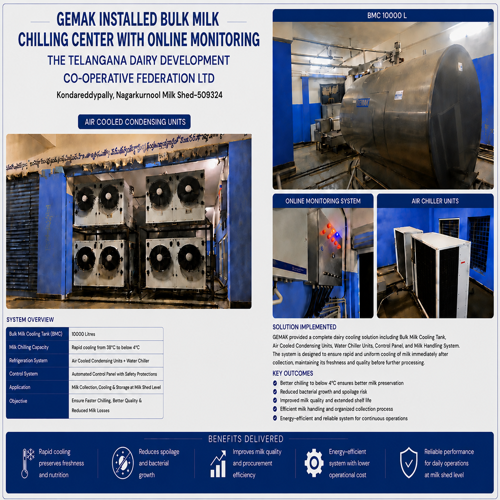
A Bulk Milk Cooler is one of the most important systems in dairy operations. It rapidly cools fresh milk immediately after collection, helping reduce bacterial growth and spoilage. This equipment is especially useful in rural milk collection centers where transportation delays are common.
Gemak Real Example:
THE TELANGANA DAIRY DEVELOPMENT CO-OPERATIVE FEDERATION LTD, Kondareddypally, Nagarkurnool Milk Shed-509324 is an example of how modern Bulk Milk Coolers can support dairy cooperatives at milk shed level. By enabling faster chilling near collection points, such equipment helps preserve milk freshness, reduce spoilage risk, improve procurement efficiency, and support better quality control before further processing.
Milk Storage Tanks
Milk storage tanks are used to store chilled milk under controlled conditions. Built with food-grade stainless steel, they support hygiene, durability, and temperature stability in dairy plants, milk collection centres, ice cream factories, and food processing units.
Pasteurizers
Pasteurisation equipment heats milk at controlled temperatures to reduce harmful bacteria while retaining nutritional value. Modern pasteurizers offer precise temperature control, automated operation, faster cycles, and consistent product quality.
Cream Separators
Cream separators efficiently divide cream and skimmed milk for products like butter, paneer, and ghee manufacturing.
CIP Cleaning Systems
Clean-In-Place systems automate equipment cleaning without dismantling machinery, improving hygiene and reducing downtime.
Automated Packaging Machines
Automated packaging machines improve filling accuracy, production speed, product safety, and shelf-life consistency. They are especially useful for packaged milk, curd, paneer, flavoured milk, and other dairy products.
Advanced Milk Chilling Systems
Milk chilling systems help maintain freshness throughout storage and transportation. With rising temperatures and expanding distribution networks, reliable chilling infrastructure has become essential for dairy businesses in India.
Modern Dairy Equipment and India’s Dairy Growth
India’s dairy sector is one of the country’s strongest agricultural industries.
According to official government data, India contributes nearly 24–25% of global milk production. However, despite being the world’s largest milk producer, much of India’s dairy sector still faces infrastructure limitations.
Rural Milk Collection Challenges
Many rural collection centers continue to struggle with:
- Delayed cooling
- Transportation losses
- Poor storage facilities
- Electricity-related challenges
This creates major opportunities for modernization.
Expanding Cold Chain Infrastructure
Cold chain development is becoming a major priority for India’s dairy industry.
Improved chilling and storage systems help:
- Reduce milk wastage
- Improve shelf life
- Maintain product quality
- Support dairy exports
Organized Dairy Sector Growth
Industry experts estimate that only around 35–40% of India’s marketable milk currently enters the organized sector. This means there is massive growth potential for modern processing infrastructure. As packaged dairy consumption rises in urban markets, investments in Modern Milk Processing Systems are increasing rapidly.
How Dairy Automation Improves Efficiency
Automation is changing dairy processing from a labour-intensive activity into a more controlled manufacturing process. Automated dairy equipment reduces manual errors, improves speed, and gives plant operators better visibility across production and cleaning cycles.
- Faster processing with fewer delays
- Reduced human error in temperature and batch control
- Improved hygiene through lower manual contact
- Better consistency across milk and dairy products
- Lower operational costs through energy-efficient systems
- Improved monitoring for quality and compliance
How Gemak Supports Modern Dairy Businesses
As dairy infrastructure evolves, businesses require equipment manufacturers that understand both efficiency and long-term reliability. Gemak has become associated with advanced stainless steel engineering solutions designed for modern dairy operations.
The company focuses on:
- Hygienic processing systems
- Durable stainless steel manufacturing
- Efficient milk cooling solutions
- Reliable dairy infrastructure
Many dairy businesses today prefer working with Gemak because modern dairy plants require more than just machinery — they require operational consistency, efficiency, and long-term performance.
Common Challenges Dairy Businesses Face
Despite rapid growth, dairy businesses still encounter several operational issues.
Storage Losses
Milk spoilage remains a major concern in areas lacking proper cooling systems.
High Power Consumption
Older machinery often consumes excessive electricity.
Hygiene Maintenance
Manual cleaning processes increase contamination risks.
Scaling Operations
Outdated systems struggle to handle increasing production volumes.This is why many businesses are now investing in Energy-Efficient Dairy Equipment and smart automation technologies.
How to Choose the Right Dairy Equipment
Selecting the right machinery requires careful planning.
Capacity Planning
Choose systems that support both current operations and future expansion.
Material Quality
Food-grade stainless steel improves hygiene and durability.
Energy Efficiency
Modern systems help reduce operational expenses over time.
Service and Support
Reliable after-sales support is critical for long-term operations.
Automation Compatibility
Future-ready systems should support digital integration and smart monitoring.
Investing in high-quality Dairy Plant Machinery helps businesses improve productivity, consistency, and operational reliability.
Future of Dairy Equipment in India
The future of India’s dairy industry will depend on automation, sustainability, digital monitoring, and stronger cold chain infrastructure. Smart dairy plants will increasingly use centralised monitoring, predictive maintenance, water-saving cleaning systems, and energy-efficient processing technologies. As packaged dairy consumption grows, modern dairy equipment will play a key role in helping cooperatives, startups, and large-scale processors improve quality, reduce wastage, and remain competitive.
FAQs About Modern Dairy Equipment
What is modern dairy equipment?
Modern dairy equipment includes advanced systems used for milk cooling, storage, processing, packaging, and quality management.
Why is modern dairy equipment important?
It improves milk quality, reduces spoilage, increases efficiency, and supports better hygiene standards.
How does dairy automation improve efficiency?
Automation reduces manual labor, improves production speed, minimizes human errors, and enhances process consistency.
Which equipment is essential in a modern dairy plant?
Essential systems include Bulk Milk Coolers, pasteurizers, storage tanks, CIP systems, and automated packaging machinery.
Is modern dairy equipment suitable for small dairy businesses?
Yes. Many scalable systems are now available for small and medium dairy operations across India.
Conclusion
India’s dairy industry is entering a new phase of modernization. As milk production continues to grow, businesses need stronger processing systems, better chilling infrastructure, hygienic storage, and reliable automation.
From Bulk Milk Coolers and pasteurizers to storage tanks and automated packaging machines, modern dairy equipment is helping dairy businesses improve quality, reduce wastage, and build future-ready operations. The businesses that invest in efficient dairy infrastructure today will be better prepared for the next stage of India’s dairy growth.