

In the dairy industry, maintaining milk quality right after collection is crucial. Even a slight delay in cooling can lead to bacterial growth and spoilage. That’s why modern milk cooling systems are an essential part of any dairy operation.
Among the most widely used technologies are DX (Direct Expansion) and IBT (Ice Bank Tank) systems. Each has its own working principle, advantages, and ideal use cases. Understanding how these systems differ helps dairy farmers and plant operators choose the most efficient solution for their needs.
What is a Milk Cooling System?
A milk cooling system is designed to rapidly reduce the temperature of fresh milk to around 4 °C. This slows down bacterial growth and preserves the milk’s freshness until processing.
Modern bulk milk coolers are engineered to:
- Maintain milk hygiene
- Extend shelf life
- Improve overall product quality
Without proper cooling, even high-quality milk can quickly lose its value.
What is a DX Milk Cooling System?
A DX (Direct Expansion) system is one of the most commonly used solutions in small to medium dairy operations.
How It Works
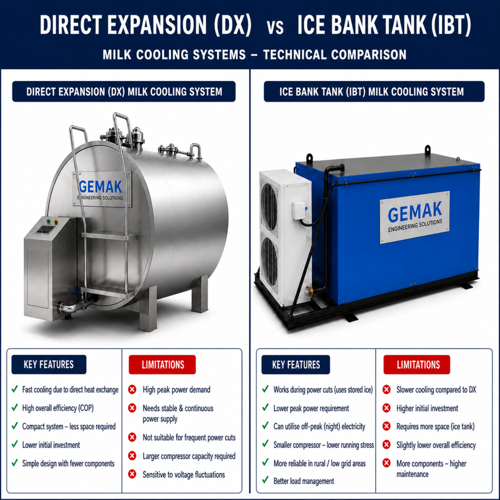
In this system, refrigerant flows directly through cooling plates attached to the tank. As milk enters the tank, heat is instantly absorbed and removed.
Key Benefits
- Fast and immediate cooling
- Simple and compact design
- Lower installation cost
- Easy maintenance
Ideal Applications
DX systems work best when:
- Milk is collected in smaller quantities
- Immediate chilling is required
- The electricity supply is consistent
What is an IBT Milk Cooling System?
An IBT (Ice Bank Tank) system uses stored ice to cool milk rather than direct refrigeration.
How It Works
Water freezes around the cooling coils during off-peak hours. When milk is added, the ice melts, and chilled water absorbs heat from the milk.
Key Benefits
- Energy-efficient operation
- Reduced peak electricity load
- Reliable even with an unstable power supply
- Suitable for large-scale operations
Ideal Applications
IBT systems are preferred when:
- Large volumes of milk are handled
- Energy savings are important
- Power supply is inconsistent
DX vs IBT Milk Cooling Systems: Key Differences
To clearly understand the difference between DX and IBT milk cooling systems, here’s a side-by-side comparison:
| Feature | DX System | IBT System |
| Cooling Method | Direct cooling | Indirect (ice-based) |
| Cooling Speed | Very fast | Moderate |
| Energy Usage | Higher during operation | Optimized with off-peak use |
| Initial Cost | Lower | Higher |
| Maintenance | Simple | Moderate |
| Power Requirement | Continuous | Flexible |
| Best Use | Small to medium farms | Large dairy plants |
Real-Life Examples
Example 1: Small Dairy Farm Using DX
A farmer collecting around 800 liters of milk daily needs instant cooling after milking. A DX system works best because:
- Milk is cooled immediately
- The setup cost is affordable
- The operation is straightforward
Example 2: Large Milk Collection Center Using IBT
A dairy center handling over 15,000 liters per day benefits from IBT technology:
- Ice is generated during low electricity demand
- Cooling continues even during power fluctuations
- Operational costs are reduced over time
Which One Should You Choose?
Selecting the right system depends on your specific requirements.
Choose DX if:
- You need rapid cooling
- Your dairy is small or medium-sized
- You have stable electricity
- You want a cost-effective solution
Choose IBT if:
- You handle large milk volumes
- Energy efficiency is a priority
- Power supply is inconsistent
- You’re planning long-term savings
Making the right choice can significantly improve your dairy efficiency and profitability.
Role of Advanced Dairy Equipment Manufacturers
The performance of any cooling system also depends on the quality of equipment used. Leading manufacturers like Gemak provide advanced solutions designed for modern dairy needs.
With a strong focus on innovation, Gemak offers reliable and efficient dairy processing equipment that supports both DX and IBT systems. Their solutions are built to ensure durability, performance, and energy optimization across different scales of operation.
FAQ
1. Which system cools milk faster?
DX systems cool milk faster because they use direct refrigeration.
2. Which system saves more electricity?
IBT systems are more energy-efficient due to off-peak ice storage.
3. Can IBT systems work during power cuts?
Yes, they can continue cooling using stored ice.
4. Is DX suitable for large dairy plants?
It can be used, but IBT is generally more efficient for large-scale operations.
5. Which system is more affordable?
DX systems typically have a lower initial investment cost.
Conclusion
Choosing between DX and IBT systems is an important decision for any dairy operation. While DX offers fast and direct cooling, IBT provides energy efficiency and reliability for larger setups.
Understanding what is the difference between DX and IBT milk cooling systems allows you to select the most suitable option based on your production scale, budget, and energy conditions.
Investing in the right milk cooling systems not only improves milk quality but also ensures long-term operational success in the competitive dairy industry.