

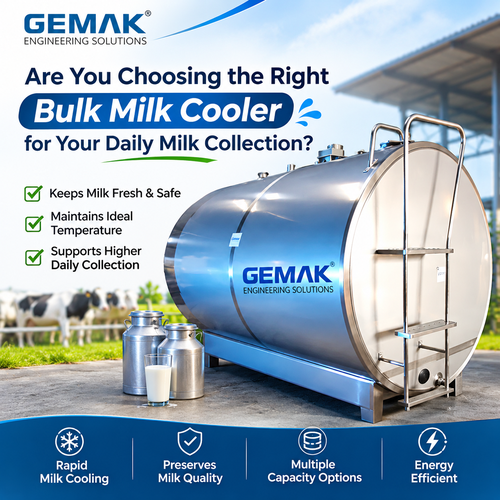
For a dairy farm or milk collection centre, every litre of milk matters. But collecting milk from multiple farmers is only one part of the operation. Maintaining its quality before transportation or processing is equally important. This is where choosing the right bulk milk cooler becomes essential.
A cooler with insufficient capacity can create operational difficulties during peak collection hours, while an unsuitable cooling system may affect efficiency and increase running costs. So, how do you decide which model is right for your business? The answer depends on your daily milk collection, cooling requirements, storage capacity, and future expansion plans.
Why Does Your Daily Milk Collection Volume Matter?
Before purchasing a bulk milk cooler, understand how much milk your dairy collects every day. The equipment should accommodate your actual collection pattern rather than an estimated average.
For example, a village-level milk collection centre receiving 250 litres in the morning may have different requirements from a cooperative collecting 900 litres across two shifts.
Three important things to evaluate are
- Daily collection: Calculate the total milk received during morning and evening collection.
- Peak volume: Consider days when more farmers supply milk than usual.
- Future growth: Account for potential increases in milk procurement over the next few years.
Selecting equipment based only on today’s average collection can create capacity limitations as your dairy business grows.
5 Important Factors to Check Before Buying a Bulk Milk Cooler
Choosing dairy cooling equipment involves more than comparing prices and tank sizes. Consider these five factors before making a purchase.
1. Capacity and Collection Pattern
Choose a capacity that accommodates your collection schedule, batch sizes, and peak milk volume. If milk arrives in multiple batches, check whether the equipment can handle the required cooling cycles efficiently.
2. Cooling Performance
Evaluate how effectively the refrigeration system brings milk to the required storage temperature. Ask manufacturers about cooling time, incoming milk temperature, batch size, and operating conditions. A suitable cooling system helps maintain consistent storage conditions.
3. Stainless Steel Construction
The tank’s material plays an important role in hygiene, durability, and cleaning. Check the grade of food-contact stainless steel, internal surface finish, welding quality, and accessibility for cleaning.
4. Electricity Consumption
Refrigeration equipment operates regularly, making energy consumption an important purchasing consideration. Compare compressor specifications, insulation quality, cooling efficiency, and estimated operating costs before selecting a model.
5. Maintenance and Technical Support
A dairy operation cannot afford unnecessary equipment downtime. Check spare-part availability, servicing arrangements, technical assistance, and the manufacturer’s after-sales support.
Which Bulk Milk Cooler Capacity Is Suitable for Your Dairy Business?
The right capacity depends on how much milk you collect, how frequently it arrives, and how quickly it needs to be chilled.
Here is an illustrative capacity-planning guide:
| Daily Milk Collection | Capacity to Evaluate | Suitable Application |
| 200–300 litres | 500 litres | Small dairy farms and collection points |
| 400–500 litres | 500–1,000 litres | Small to medium dairy operations |
| 800–1,000 litres | 1,000–1,500 litres | Growing milk collection centres |
| 1,000–2,000 litres | 2,000–4,000 litres | Medium to large dairy operations |
Note: These are indicative planning examples, not fixed engineering recommendations. Final capacity selection depends on batch size, collection frequency, cooling cycle, incoming milk temperature, and manufacturer specifications.
For instance, a centre collecting 500 litres in two separate batches may have different requirements from one receiving the entire quantity at once. Always discuss your collection pattern with the equipment manufacturer before finalising the model.
What Does India’s Growing Dairy Industry Mean for Milk Chilling Infrastructure?
India’s dairy industry continues to play an important role in the country’s agricultural economy. According to the Government of India’s Department of Animal Husbandry and Dairying, the country produced 247.87 million tonnes of milk during 2024–25, registering a growth of 3.58% over the previous year.
The same report recorded India’s per capita milk availability at 485 grams per day, maintaining the country’s position as the world’s largest milk producer.
These figures highlight the scale of India’s dairy sector. As milk production and procurement activities expand, efficient collection, storage, and chilling infrastructure become increasingly important for dairy businesses.
For farmers, cooperatives, and milk procurement centres, investing in suitable milk cooling equipment can support better-organised collection and storage operations.
Source: Basic Animal Husbandry Statistics 2025 – Government of India.
A Practical Example: Choosing a Cooler for 600 Litres of Daily Collection
Consider a dairy entrepreneur collecting approximately 600 litres of milk every day from nearby villages.
Initially, a 500-litre cooler might appear sufficient because the daily collection is close to its capacity. However, the entrepreneur must also consider whether the milk arrives in one batch or multiple batches, the time between collections, and the cooling system’s ability to handle incoming milk.
If collection increases during certain seasons, the existing arrangement may become restrictive.
Instead of purchasing equipment based only on the current volume, the entrepreneur should compare suitable capacity options, cooling performance, electricity requirements, and future expansion plans.
This simple assessment can help avoid an unsuitable purchase and unnecessary equipment upgrades.
Why Consider Gemak for Your Dairy Equipment Requirements?
Selecting the right manufacturer is as important as selecting the right capacity. Buyers should evaluate product construction, cooling configurations, hygiene requirements, technical specifications, and after-sales support.
Gemak Engineering Solutions manufactures dairy processing equipment, including bulk milk coolers, milk storage tanks, and silos. Its bulk milk cooler range includes capacities from 100 to 2,000 litres, according to its official product information.
Businesses exploring dairy cooling solutions can review Gemak Bulk Milk Coolers to understand the available equipment options and identify models relevant to their operational requirements.
The right investment begins with understanding your milk collection needs and discussing the technical specifications with an experienced equipment supplier.
Frequently Asked Questions About Bulk Milk Coolers
1. What capacity bulk milk cooler is suitable for a small dairy farm?
A 500-litre model may be worth evaluating for a small dairy farm collecting approximately 200–300 litres daily. However, the final selection depends on batch size, collection frequency, cooling requirements, and future production plans.
2. How long does a bulk milk cooler take to chill milk?
Cooling time depends on the incoming milk temperature, quantity, refrigeration capacity, and equipment configuration. Ask the manufacturer for verified cooling performance under specified operating conditions before purchasing.
3. What should I check before purchasing a bulk milk cooler in India?
Check tank capacity, food-contact stainless steel grade, cooling performance, electricity consumption, cleaning arrangements, maintenance requirements, warranty, and after-sales support. Also compare the equipment specifications with your actual daily milk collection.
Conclusion
Choosing the right bulk milk cooler is a practical investment in your dairy operation. Before purchasing, evaluate daily milk collection, peak requirements, cooling performance, hygiene, energy consumption, and future expansion. A well-matched system can make milk collection and storage more organised. Explore Gemak’s dairy equipment solutions and discuss your operational requirements before selecting the right cooling equipment.