

Milk is one of the most sensitive food products in the dairy industry. From the moment it is collected, maintaining its quality depends on proper storage. Even a small rise in temperature or poor handling can encourage bacterial growth, reducing shelf life and affecting taste, safety, and processing efficiency.
Whether you operate a small dairy farm, a village milk collection center, or a large dairy processing plant, choosing the right milk storage tank is one of the most important investments you can make. Different tanks are designed for different stages of milk handling, storage capacity, and cooling requirements.
In this guide, we’ll explain the different types of milk storage tanks, where each one is used, how to choose the right option for your dairy operation, and the insulation systems that help maintain milk quality.
Why Milk Storage Tanks Matter
Fresh milk begins to deteriorate soon after milking. According to dairy industry guidelines, raw milk should be cooled to approximately 4°C within a few hours to limit bacterial multiplication and preserve its natural quality.
Modern milk storage tanks are designed to:
- Maintain consistent milk temperature
- Prevent contamination
- Preserve nutritional value
- Extend storage time before processing
- Reduce spoilage losses
- Improve dairy plant efficiency
A properly selected storage tank not only protects milk quality but also reduces operational costs over time.
Types of Milk Storage Tanks
Different dairy operations require different storage solutions. Below are the most commonly used milk storage tanks.
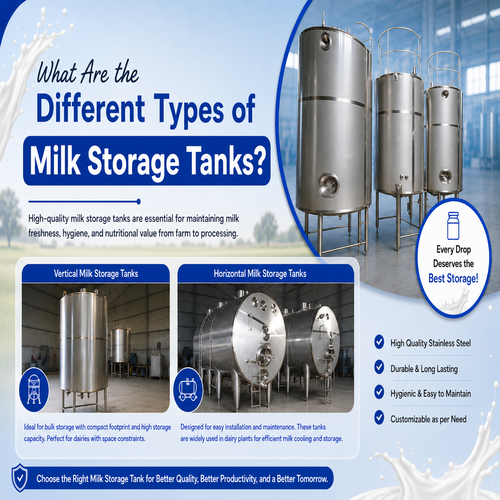
1. Vertical Milk Storage Tanks
Vertical tanks are among the most popular options for dairy farms and processing plants where floor space is limited.
Features
- Cylindrical vertical design
- Stainless steel construction
- Available with insulated walls
- Easy to clean
- Suitable for medium and large capacities
Best For
- Dairy processing plants
- Milk chilling centers
- Commercial dairy farms
Advantages
- Saves floor space
- Excellent insulation
- Easy integration with automated systems
- Lower installation footprint
2. Horizontal Milk Storage Tanks
Horizontal tanks are commonly installed where ceiling height is restricted or easy accessibility is required.
Features
- Horizontal cylindrical structure
- Large manholes
- Efficient agitator systems
- Suitable for bulk storage
Best For
- Large dairy farms
- Milk transportation hubs
- Processing facilities
Advantages
- Easier inspection
- Convenient maintenance
- Better accessibility for operators
- Stable installation
3. Insulated Milk Storage Tanks
These tanks primarily maintain milk temperature rather than actively cooling it.
Features
- Double-wall construction
- Polyurethane insulation
- Stainless steel body
- Temperature retention
Ideal For
- Short-term storage
- Dairy transportation
- Intermediate holding
Advantages
- Maintains milk temperature
- Energy efficient
- Reduces temperature fluctuations
Choosing the Right Milk Storage Tank
The best storage tank depends on several operational factors.
Milk Volume
A small dairy farm producing 500 liters daily has different requirements than a dairy processing plant handling 50,000 liters.
Cooling Requirement
If milk remains on-site for several hours before collection, refrigerated storage is usually essential.
Available Space
Vertical tanks maximize storage in limited floor areas, while horizontal tanks are often easier to maintain and access.
Automation
Modern dairy operations often prefer tanks with:
- Digital temperature monitoring
- Automatic agitators
- CIP cleaning systems
- Remote monitoring
Energy Efficiency
High-quality insulation and efficient refrigeration systems significantly reduce electricity consumption over the equipment’s lifetime.
Real-World Example
A dairy cooperative in northern India collecting approximately 8,000 liters of milk daily experienced recurring quality issues during the summer months. Milk temperatures often remained above recommended levels before transportation, leading to increased bacterial counts and occasional rejection by the processing plant.
After replacing conventional storage with refrigerated bulk milk cooling tanks equipped with automatic temperature control and continuous agitation, the cooperative observed:
- Improved milk quality consistency
- Reduced spoilage during storage
- Better acceptance rates at the processing plant
- Lower operational losses associated with rejected milk
This example illustrates how selecting the appropriate storage solution can improve operational efficiency and protect product quality.
Expert Insight
Dairy engineering professionals consistently emphasize that milk storage is not merely about holding milk—it is about preserving its quality until processing.
Key design considerations include:
- Food-grade SS304 stainless steel
- Uniform cooling performance
- Reliable insulation
- Easy cleaning through CIP systems
- Accurate temperature monitoring
- Gentle agitation to prevent cream separation
Maintenance Tips for Milk Storage Tanks
Proper maintenance extends equipment life and ensures safe milk handling.
Recommended practices include:
- Clean the tank after every milk collection cycle.
- Inspect agitators regularly.Replace worn seals and gaskets.
- Perform scheduled preventive maintenance.
- Follow food safety sanitation protocols.
Routine maintenance minimizes contamination risks and reduces unexpected downtime.
Why Stainless Steel Is the Preferred Material
- Verify temperature controller accuracy.
- Check refrigeration system performance.
Nearly all modern milk storage tanks are manufactured from food-grade stainless steel because it offers:
- Excellent corrosion resistance
- Smooth hygienic surface
- Easy cleaning
- Long service life
- High durability
- Compliance with food safety standards
These properties make stainless steel the industry standard for dairy equipment.
Cold Insulation Specification
Proper cold insulation is essential for Horizontal Milk Storage Tanks, Vertical Milk Storage Tanks, Pasteurized Milk Storage Tanks, and Bulk Milk Coolers. A well-designed insulation system ensures that the temperature rise of stored milk does not exceed 1°C within 24 hours, helping preserve freshness, quality, and food safety.
Type I – Three-Layer Cold Insulation System
| Component | Specification |
| Applicable Equipment | Horizontal Milk Storage Tank, Vertical Milk Storage Tank, Pasteurized Milk Storage Tank & Bulk Milk Cooler |
| Performance Requirement | Maximum temperature rise of 1°C in 24 hours |
| Surface Preparation | Black Bituminous Paint applied on outer surface of inner shell |
| First Layer | 15 mm Polyurethane Foam (PUF) Slab, Density: 30–35 kg/m³, Radial application |
| Second Layer | 50 mm Expanded Polystyrene (EPS), Density: 16–20 kg/m³, Longitudinal application |
| Third Layer | 50 mm Expanded Polystyrene (EPS), Density: 16–20 kg/m³, Radial application |
| Joint Arrangement | Staggered joints to reduce thermal bridging |
| Joint Sealing | All joints sealed with bitumen to prevent moisture ingress |
| Structural Support | Suitable stiffeners as per approved design |
| Outer Cladding | Continuously welded for complete sealing |
| Bottom Support | Bottom channel properly grouted to eliminate moisture accumulation |
Key Benefits
- Excellent thermal insulation
- Better energy efficiency
- Reduced moisture penetration
- Long service life
- Improved milk quality preservation
Type II – Injected Polyurethane Foam (PUF) Insulation
| Specification | Details |
| Insulation Material | CFC-Free Injected Polyurethane Foam |
| Density | 40–45 kg/m³ |
| Thickness | 50–100 mm (Project dependent) |
| Application | Uniform injected insulation without voids |
| Thermal Performance | Maximum temperature rise of 1°C in 24 hours |
| Moisture Resistance | High |
| Thermal Conductivity | Low |
| Dimensional Stability | Excellent |
| Outer Protection | Suitable cladding and structural supports |
Advantages
- Superior thermal insulation
- Uniform insulation without gaps
- Reduced refrigeration load
- Longer equipment lifespan
- Better operational efficiency
Hot Insulation Specification
Hot insulation is used in dairy processing tanks to minimize heat loss while maintaining product temperature during storage and processing.
Hot Insulation Construction Details
| Component | Specification |
| Purpose | Minimize heat loss and maintain product temperature |
| Surface Preparation | One coat of Black Bituminous Paint Grade 85/25 |
| First Layer | 50 mm Loose Rock Wool Blanket (Density: 120 kg/m³) |
| Second Layer | Additional 50 mm Loose Rock Wool Blanket (Density: 120 kg/m³) |
| Joint Arrangement | Staggered joints for uniform insulation |
| Retaining Layer | Galvanized Chicken Wire Mesh |
| Moisture Protection | Insulation free from gaps and moisture contamination |
| Outer Cladding | Properly sealed or continuously welded |
| Structural Support | Suitable stiffeners and supports provided |
| Performance | Maintains desired product temperature and minimizes heat transfer |
Benefits of Hot Insulation
| Benefit | Description |
| Reduced Heat Loss | Improves thermal efficiency |
| Energy Savings | Lowers operating costs |
| Operator Safety | Reduces outer surface temperature |
| Moisture Protection | Prevents insulation deterioration |
| Longer Equipment Life | Protects against corrosion and thermal stress |
| Reliable Processing | Maintains stable product temperature during operations |
Why Proper Insulation Matters
Choosing the right insulation system is just as important as selecting the correct milk storage tank. Whether you are using a Vertical Milk Storage Tank, Horizontal Milk Storage Tank, Pasteurized Milk Storage Tank, or a Bulk Milk Cooler, effective insulation minimizes energy consumption, reduces temperature fluctuations, prevents bacterial growth, and improves the overall performance of dairy operations. High-quality insulation systems, like those incorporated into Gemak dairy equipment, help ensure long-term reliability, efficient cooling, and compliance with modern dairy hygiene standards.
Final Thoughts
Milk storage tanks play a critical role in maintaining milk quality from collection to processing. The right solution depends on production capacity, storage duration, available space, cooling requirements, insulation quality, and operational goals.
Whether choosing a vertical tank, horizontal tank, insulated storage tank, transport tank, or a bulk milk cooler, investing in reliable, hygienically designed equipment helps preserve freshness, improve operational efficiency, and reduce product losses.
For dairy businesses aiming to strengthen quality assurance and long-term productivity, selecting well-engineered storage solutions from experienced manufacturers like Gemak can provide dependable performance, efficient cooling, advanced insulation, and compliance with modern dairy industry standards. By matching the appropriate tank type and insulation system to your specific application, you create a more reliable milk handling process that benefits both producers and consumers.