

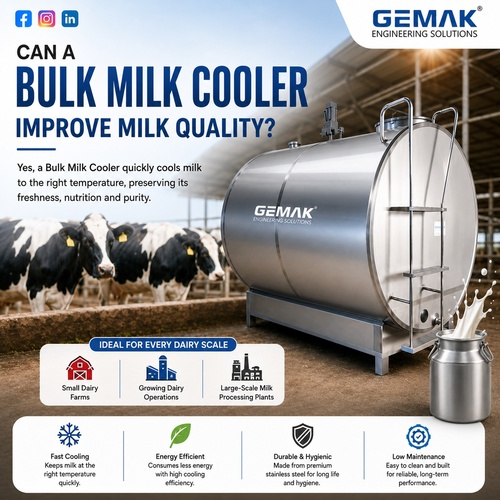
The answer is yes—a bulk milk cooler (BMC) is one of the most effective investments for improving milk quality on dairy farms and milk collection centers. It rapidly cools freshly collected milk to the recommended storage temperature, slowing bacterial growth, preserving nutritional value, and maintaining freshness until processing.
For dairy farmers, milk cooperatives, and processors, maintaining milk quality isn’t just about hygiene during milking. The time between milking and processing is equally critical. Without proper cooling, even hygienically collected milk can deteriorate within hours, leading to reduced quality, lower prices, and higher rejection rates.
This guide explains how a bulk milk cooler works, why rapid cooling matters, what research says, and how dairy businesses benefit from installing one.
Why Milk Quality Declines After Milking
Fresh milk leaves the udder at approximately 35–37°C. At this temperature, naturally occurring bacteria and environmental microorganisms multiply rapidly.
Within a few hours, warm milk can experience:
- Increased bacterial count
- Higher acidity
- Reduced freshness
- Off-flavors
- Lower processing efficiency
- Shorter shelf life
The faster milk is cooled, the slower bacteria multiply.
According to internationally accepted dairy handling practices, raw milk should ideally be cooled to 4°C or below as quickly as possible after collection to preserve its quality.
What Is a Bulk Milk Cooler?
A Bulk Milk Cooler (BMC) is a refrigerated stainless-steel tank specifically designed to cool and store raw milk immediately after milking.
It performs three essential functions:
- Rapid cooling
- Uniform temperature maintenance
- Hygienic storage
Unlike ordinary storage tanks, a BMC continuously maintains milk at the desired temperature while gently agitating it to ensure uniform cooling without damaging milk composition.
How Does a Bulk Milk Cooler Improve Milk Quality?
1. Rapid Cooling Slows Bacterial Growth
Temperature is the biggest factor affecting bacterial multiplication.
When milk remains warm:
- Bacteria double rapidly.
- Acidity rises.
- Spoilage begins.
A bulk milk cooler quickly lowers milk temperature, significantly slowing bacterial growth and preserving freshness.
Example
Imagine two dairy farms producing identical milk.
Farm A
- Milk stored in cans for three hours before transport
Farm B
- Milk cooled immediately using a Bulk Milk Cooler
Even though both farms started with similar milk quality, Farm B is far more likely to deliver milk with:
- Lower bacterial count
- Better freshness
- Higher acceptance rate at the dairy plant
2. Preserves Nutritional Quality
Proper cooling helps retain important nutrients including:
- Protein
- Calcium
- Vitamins
- Milk fat quality
While cooling does not increase nutritional value, it helps prevent quality deterioration caused by bacterial activity.
3. Improves Shelf Life
One of the biggest advantages of a bulk milk cooler is extending the usable life of raw milk before processing.
Proper cooling:
- Delays spoilage
- Maintains freshness
- Supports transportation over longer distances
- Allows flexible collection schedules
This is especially valuable for remote dairy farms where immediate transportation isn’t always possible.
4. Maintains Consistent Milk Temperature
Modern bulk milk coolers continuously monitor and regulate temperature.
Benefits include:
- Uniform cooling
- No hot spots
- Reduced quality variation
- Better compliance with dairy standards
Consistent cooling improves processing efficiency at the dairy plant.
5. Reduces Milk Rejection
Milk processors routinely test incoming milk for:
- Temperature
- Bacterial count
- Acidity
- Overall quality
Milk that exceeds acceptable limits may be rejected or purchased at a lower price.
A properly maintained bulk milk cooler helps producers consistently meet quality requirements.
Expert Perspective
Dairy quality specialists generally agree that rapid cooling is one of the most effective methods of preserving raw milk quality after milking. Good milking hygiene remains essential, but without immediate cooling, bacterial growth can quickly offset those hygiene efforts.
The combination of clean milking practices + fast cooling + proper storage forms the foundation of high-quality milk production.
Case Study: Small Dairy Cooperative
A village milk collection center serving approximately 180 dairy farmers experienced frequent complaints regarding high bacterial counts during summer.
Before Installing a Bulk Milk Cooler
- Milk remained at ambient temperature for 2–3 hours.
- Increased souring during transport.
- Higher rejection rates at the processing plant.
- Inconsistent payments due to quality issues.
After Installing a Bulk Milk Cooler
Within a few months, the cooperative observed:
- Lower bacterial counts in collected milk
- Improved freshness at delivery
- Fewer quality-related deductions
- Better confidence among buyers
- Reduced product wastage
While results vary depending on hygiene, handling, and maintenance practices, this reflects a common outcome reported by many dairy collection centers that implement prompt cooling.
Additional Benefits Beyond Milk Quality
Better Farmer Income
Higher-quality milk often receives better pricing in quality-based payment systems.
Reduced Waste
Cooling minimizes spoilage, reducing milk losses.
Improved Processing Efficiency
Consistent milk quality supports:
- Better pasteurization
- Stable product quality
- Higher production efficiency
Energy-Efficient Operation
Modern bulk milk coolers are designed for:
- Faster cooling cycles
- Improved insulation
- Lower operating costs
- Reliable performance
Factors That Influence Milk Quality Besides Cooling
Although a bulk milk cooler plays a major role, several other factors also affect milk quality:
| Factor | Impact |
| Animal health | Healthy animals produce better-quality milk |
| Milking hygiene | Reduces contamination |
| Clean equipment | Prevents bacterial introduction |
| Water quality | Supports sanitation |
| Proper storage | Maintains freshness |
| Regular maintenance | Ensures consistent cooling performance |
A bulk milk cooler works best as part of an overall milk quality management program.
Is a Bulk Milk Cooler Worth the Investment?
For most commercial dairy farms, milk collection centers, and cooperatives, the answer is yes.
A quality bulk milk cooler can provide long-term value by:
- Improving milk quality
- Reducing spoilage
- Increasing shelf life
- Supporting food safety
- Enhancing buyer confidence
- Lowering rejection rates
- Improving operational efficiency
Over time, these benefits can outweigh the initial investment through reduced losses and more consistent product quality.
Choosing the Right Bulk Milk Cooler
When selecting a bulk milk cooler, consider:
- Required storage capacity
- Cooling performance
- Energy efficiency
- Stainless steel construction
- Automatic temperature control
- Ease of cleaning
- Availability of service support
- Compliance with dairy industry standards
Working with an experienced manufacturer helps ensure the equipment matches your production needs and local operating conditions.
Frequently Asked Questions (FAQs)
Does a bulk milk cooler increase milk production?
No. It does not increase milk yield, but it preserves the quality of the milk that is produced.
What temperature should milk be stored in a bulk milk cooler?
Raw milk should generally be cooled and maintained at around 4°C or below, depending on applicable local regulations and processor requirements.
Can small dairy farms use a bulk milk cooler?
Yes. Bulk milk coolers are available in a range of capacities suitable for small, medium, and large dairy operations.
How quickly should milk be cooled after milking?
Milk should be cooled as soon as possible after collection to minimize bacterial growth and maintain quality.
Does cooling replace good hygiene practices?
No. Cooling complements, but does not replace, proper milking hygiene, equipment sanitation, and healthy herd management.
Final Verdict
A bulk milk cooler is one of the most important pieces of equipment for protecting milk quality after milking. By rapidly lowering and maintaining the milk’s temperature, it slows bacterial growth, preserves freshness, supports food safety, extends storage time, and helps dairy farms and collection centers consistently deliver higher-quality milk.
While cooling alone cannot compensate for poor hygiene or unhealthy animals, it is a critical part of an effective dairy quality management system. For farms aiming to reduce spoilage, meet processor standards, and improve operational efficiency, investing in a reliable bulk milk cooler is a practical and worthwhile step.