

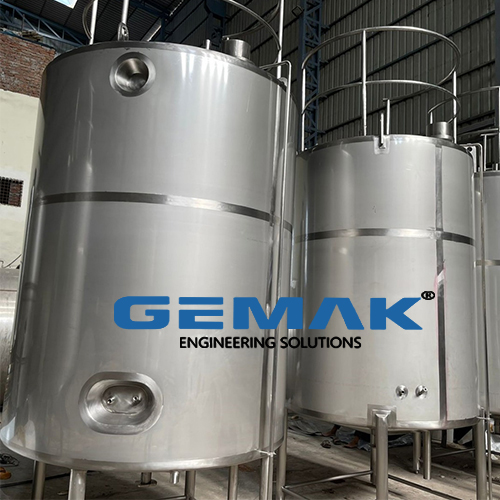
Why is an hour more important than most dairy factories can imagine?
One shocking discovery in the dairy industry is that raw milk can start to develop measurable bacterial growth within 20 minutes upon increase in storage temperature by a few degrees on top of target, a reason why a single wall storage choice can impact a complete production cycle. That is how a Milk Storage Tank is not merely a holding tank; it is the unspoken system that preserves flavour, shelf life and processing consistency since milk is received at a facility.
Today a modern Milk Storage Tank is almost like a temperature-control vault, where milk is stored every day with the other activities like the collection of milk, testing of milk and processing of milk goes on without delay. Regardless of the type of facility, i.e., Horizontal Milk Storage Tank or Vertical Milk Storage Tank or a Silo, the end result is the same, which is to maintain freshness without causing unnecessary loss of temperature.
A Stainless Steel Milk Storage Tank enhances hygiene as well since smooth internal surfaces minimize residue formation and make it easier to clean between cycles. Most dairy operators continue to evaluate each Milk Tank type based on the capacity, but insulation, agitation control, usually prove to be more important than size in the long run. An early choice of the right Milk Storage Tank results in a more predictable dairy workflow, particularly when supply peaks on a seasonal basis.
Where a Milk Storage Tank Is a Feasible Addition to Dairy Operations
A Milk Storage Tank assists in almost all steps between gathering and final processing since milk is not allowed to accumulate until production schedules are caught up. In collection Centre’s, milk will be received at the Centre with different temperatures in this case the initial storage facility will have to stabilize the milk as soon as possible, and that is where a Stainless Steel Milk Storage Tank will be valuable since stainless steel will help to reduce the risk of contamination and provide multiple wash-ups.
A Horizontal Milk Storage Tank is commonly used in medium sized dairy facilities where floor space is more suited to wide equipment than tall installations. Its reduced height also enables easy accessibility to inspect, adjust the valves and perform routine maintenance in small processing rooms. When the production volume is high, limited space on the floor will often be used then Vertical Milk Storage Tank will be used. Facilities are constructed vertically, rather than horizontally, and maintain precious movement space around filling and transfer lines.
A Silo Milk Tank is used in large dairy plants which are fed constant bulk milk via tanker unloading systems. These tanks are like reserve banks that store thousands of litres of milk at constant temperature until pasteurization commences. Even the size of a typical Milk Tank in a small dairy can enhance scheduling since milk does not have to be processed immediately after every collection cycle. That’s how flexibility minimizes labour strain at peak morning intake.
Storage Benefits that Have a Direct influence on the quality of milk
- A Milk Storage Tank is an equipment that ensures protection of quality through simultaneous control of three important factors: temperature, movement, and exposure.
- The most significant consideration is temperature due to the reaction that raw milk is sensitive to when temperatures slow down.
- In many industry reports, milk kept at temperatures close to 4 degree Celsius has a much longer safe bacterial stability compared to the milk kept in cooling cycles which vary.
- A Horizontal Milk Storage Tank is commonly used to ensure consistent storage of milk.
- A Milk Tank is particularly helpful where continuous storage is required since the larger the insulated walls, the slower the temperature drift during extended operating hours. Controlled agitation is also a feature of a reliable Milk Tank and prevents the separation of creams without destroying the structure.
Making Comparisons of Tank Designs prior to investment decisions
The choice of Milk Storage Tank must be based on the workflow, rather than the budget at hand. Others purchase overcapacity systems prematurely only to realize that the cleaning processes take much time. Others adopt small units, and then experience a re-occurring delay of transfer as the intake grows.
Horizontal and Vertical Storage Performance Overview
| Tank Type | Best Application | Space Requirement | Cleaning Access | Storage Capacity |
| Vertical Milk Storage Tank | Limited floor space | Compact footprint | Ladder access needed | High |
| Stainless Steel Milk Storage Tank | Hygienic storage across all scales | Flexible | Excellent | Variable |
| Silo Milk Tank | Industrial dairy plants | Tall installation zone | Automated systems common | Very high |
- Horizontal Milk Storage Tank can be effective in case of milk movement in small batches with multiple shifts.
- A Vertical Milk Storage Tank is appropriate in plants where expansion is anticipated in the future since vertical systems are more easily expanded.
- A Silo Milk Tank gets economically powerful as the intake volume is consistently large.
The reasons why our Milk storage tanks are the preferred choice of facilities
Milk Storage Tank works best when constructed around real dairy handling action as opposed to more commonly used dimensions. This is why our systems are set up based on the knowledge of how milk is in, how it stays and how it leaves every facility.
All Stainless Steel Milk Storage Tanks are of food grade construction with polished inside finishing which facilitates deep cleaning. That is very important since on the surface, microscopic irregularities may harbour residues that are not visible in a fast examination.
Our models of Horizontal Milk Storage Tanks are designed to provide stable cooling on the entire length of a tank which prevents hot spots along the edges. The Vertical Milk storage tanks are also designed to be discharge efficient in order to ensure that the milk leaves the tank without any unnecessary retention. One of our production line Silo Milk Tanks has insulation layers that aid in keeping the target temperature even when the outside temperature changes. This is particularly important in areas where the daytime temperatures increase drastically. All Milk Tanks passes through pressure and weld integrity tested prior to shipment since weak seams tend to manifest themselves only after several cycles of temperature extremes.
Trends in Milk storage tank technology in the future
A Milk Storage Tank is growing smarter due to the growing desire of dairy plants to have storage systems that report real time performance. Temperature change is measured every few seconds with sensors, as opposed to manual measurements. This implies that a Milk Storage Tank can alert the operators when milk temperature comes to a level that will compromise the quality of milk.
To avoid the unnecessary movements, some developed Horizontal Milk Storage Tank systems have a digital agitation timing which helps in saving energy.
Automated Cleaning Systems are also being matched with a Vertical Milk Storage Tank to minimize the use of water when cleaning. This is important since dairy cleaning can end up using more water than most operators anticipate.
- A Stainless Steel Milk Storage Tank will probably be a leading one since stainless steel continues to provide the best combination of hygiene and life cycle.
- A Silo Milk Tank could also have predictive maintenance sensors that could detect insulation weakness before any temperature loss can be noticed.
- The basic Milk Tank will now have to be log data as compliance requirements keep increasing.
Conclusions on the selection of improved milk storage protection
A Milk Storage Tank is one of the most profitable dairy investments since it affects all the batches but does not require constant supervision. With proper storage, the quality of milk remains the same, production times proceed without a hitch and wastage of material is kept at a minimum.
Storage Systems at Gemak Engineering Solutions, are developed with this long-term operational impact in mind, which assist the dairy units to have reliable performance on a daily basis. A Horizontal Milk Storage Tank can provide a viable benefit to medium-scale operations where convenient access and floor mounting are important. The Vertical Milk Storage Tank is the more robust option when the facilities require more storage with minimal increase in the floor area. A Stainless Steel Milk Storage Tank remains the industry favourite due to the fact that hygienic requirements require durable surfaces which are easy to clean and cannot be contaminated. A Silo Milk Tank helps to maintain continuous production in larger dairy facilities where bulk milk cannot be held during processing phases.
When designed by Gemak Engineering Solutions, the right Milk Tank aids in minimizing the loss that occurs without being detected as the milk quality is compromised in storage through transfer. Good storage is never an attraction, but it silently dictates the level of success in dairy quality survival at all stages of production.
Frequently Asked Questions on the selection of milk storage tanks
Q 1. What is the maximum amount of time that milk can be kept in a Milk Storage Tank?
When temperatures are regulated within acceptable dairy levels, a well cooled Milk Storage Tank can safely hold raw milk up to 48 hours.
Q 2. Horizontal Milk Storage Tank or Vertical Milk Storage Tank- Which is better?
Horizontal Milk Storage Tank is more suitable in broad layouts and Vertical Milk Storage Tank occupies less space in small plants.
3. Reasons why Stainless Steel Milk Storage Tank is preferred?
A Stainless Steel Milk Storage Tank has a high level of hygiene, corrosive resistance and ease of cleaning than most other materials.
4. When does the Silo Milk Tank need to be chosen?
The Silo Milk Tank is the perfect choice when the amount of dairy consumed is large enough that bulk storage is worthwhile.
Q 5. Is it required that each dairy unit has a special Milk Tank?
An adequately selected Milk Tank enhances reliability in storage even in a small level of operation since the quality of milk is very sensitive to the holding conditions.