

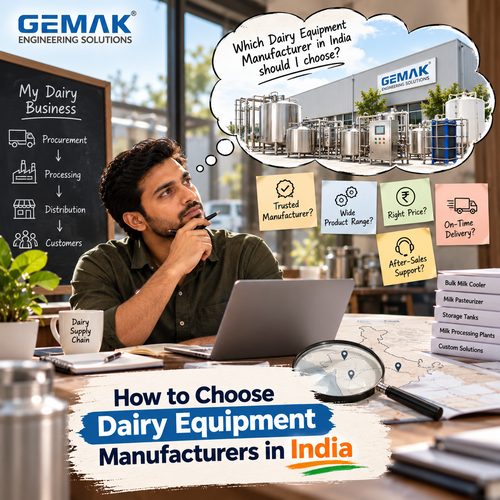
Choosing the wrong dairy equipment can increase operating costs, cause production delays, and compromise milk quality. If you’re planning to set up or expand a dairy business, finding reliable dairy equipment manufacturers in India is an important first step. From bulk milk coolers to milk storage tanks, the right equipment can improve efficiency, support hygienic milk handling, and prepare your business for future growth.
According to the Government of India’s Basic Animal Husbandry Statistics 2025, India produced an estimated 247.87 million tonnes of milk in 2024–25, representing a 3.58% increase over the previous year. This scale of production highlights the importance of suitable dairy infrastructure, although equipment requirements vary significantly between businesses. (Source: Department of Animal Husbandry and Dairying.)
Why Choosing the Right Dairy Equipment Manufacturer Matters
Dairy equipment directly affects how milk is collected, chilled, processed, transferred, and stored. Inadequate equipment selection can create operational bottlenecks, increase maintenance requirements, and complicate hygiene management.
For example, a milk collection centre handling several collection rounds daily needs sufficient chilling capacity to manage incoming milk without disrupting operations. Similarly, a commercial processing plant may require pasteurisation equipment, storage tanks, transfer pumps, and an organised processing workflow.
Reliable equipment should match the business’s actual requirements rather than simply offer the lowest purchase price. Buyers should also consider cleaning procedures, installation conditions, energy consumption, and access to technical support.
Types of Equipment Offered by Dairy Equipment Manufacturers in India
Dairy equipment manufacturers supply different machinery depending on their product range and the needs of their customers. Common categories include:
- Bulk milk coolers: Used to chill collected milk and help manage temperature before further processing.
- Milk pasteurisers: Used for controlled heat treatment designed to reduce harmful microorganisms.
- Stainless steel milk storage tanks: Used to store milk under suitable hygienic and temperature-controlled conditions.
- Milk transfer systems: Help move milk between collection, storage, and processing stages.
- Milk reception equipment: Supports milk intake, measurement, filtration, and handling.
- Cleaning-in-place systems: Where appropriate, these systems help clean compatible processing equipment without dismantling the entire installation.
The correct combination depends on milk volume, product range, processing method, available utilities, and expansion plans. A small collection centre will not necessarily need the same equipment as a plant producing packaged milk, curd, paneer, or other dairy products.
How to Evaluate Dairy Equipment Manufacturers in India
Before finalising a supplier, evaluate the following factors.
1. Manufacturing quality and material suitability
Ask for detailed technical specifications, fabrication details, and information about materials that come into contact with milk. Stainless steel grade, surface finish, weld quality, and cleanability are important considerations for hygienic processing.
Verify that the proposed materials and design are appropriate for the intended application.
2. Capacity and customisation
Calculate daily milk volume, peak collection requirements, operating hours, and expected future demand. Equipment should be selected according to the actual process rather than an arbitrary capacity estimate.
For instance, a business collecting milk in several batches may need to assess peak inflow and cooling performance, not just its average daily volume.
3. Hygiene and regulatory requirements
Food safety depends on suitable equipment design, cleaning practices, time-temperature controls, and appropriate handling procedures. The Food Safety and Standards Authority of India’s milk guidance highlights the importance of controlling temperature throughout milk handling and processing.
Buyers should confirm applicable food safety requirements and request relevant compliance documentation from suppliers.
4. Installation and after-sales service
Check whether the manufacturer provides installation guidance, commissioning support, operating instructions, spare parts, warranty coverage, and maintenance assistance.
A competitively priced machine may become costly if technical support is difficult to obtain when a fault interrupts production.
5. Total cost of ownership
Compare more than the initial quotation. Consider electricity consumption, cleaning requirements, maintenance, replacement parts, downtime, and expected service life.
Request itemised quotations from shortlisted suppliers so you can compare equipment specifications and included services fairly.
Real Data: What India’s Dairy Production Means for Equipment Buyers
Government statistics provide useful context for planning dairy infrastructure.
According to the Department of Animal Husbandry and Dairying, India produced 239.30 million tonnes of milk in 2023–24 and an estimated 247.87 million tonnes in 2024–25. Per capita milk availability reached 485 grams per day in 2024–25.
The five largest milk-producing states in 2024–25 were Uttar Pradesh, Rajasthan, Madhya Pradesh, Gujarat, and Maharashtra. Together, they accounted for 54.09% of India’s milk production. (Source: Basic Animal Husbandry Statistics 2025.)
These figures demonstrate the scale and geographical distribution of milk production. They do not, by themselves, establish the number of dairy equipment manufacturers or prove that every region has the same machinery requirements.
For equipment buyers, the practical implication is to assess local milk collection patterns, transport distances, processing needs, service availability, and the infrastructure required to maintain milk quality.
Practical Example: Selecting Equipment for a Dairy Business
Consider an illustrative dairy cooperative collecting 2,000 litres of milk per day. Before purchasing a bulk milk cooler, its procurement team should examine the volume received during peak collection periods, the required cooling performance, available electricity, cleaning arrangements, and space for installation.
The team could compare two supplier quotations using the following criteria:
- Suitable equipment capacity and cooling specifications.
- Construction materials and hygienic design.
- Installation and commissioning requirements.
- Warranty terms and spare parts availability.
- Energy requirements and estimated maintenance costs.
The cooperative should request technical documentation and verify the proposed system against its operating conditions. The example is hypothetical; actual capacity selection requires an assessment of collection schedules, milk temperature, ambient conditions, and equipment specifications.
Why Consider Gemak for Dairy Equipment Requirements?
Gemak Engineering Solutions is a relevant brand for businesses exploring dairy equipment options. Buyers can evaluate its available product range against their specific requirements for milk chilling, storage, and processing.
When assessing Gemak, procurement teams should review the relevant product specifications, construction materials, available capacities, installation requirements, and after-sales support. They should also confirm that the proposed equipment is suitable for their milk volume and intended application.
Businesses considering a bulk milk cooler or a milk storage tank should discuss their operating requirements with the supplier before requesting a quotation. This helps establish whether the proposed equipment fits the planned workflow and future capacity needs.
Common Mistakes to Avoid When Buying Dairy Equipment
Some purchasing mistakes can create avoidable operational problems:
- Choosing equipment based only on the lowest quotation.
- Ignoring peak milk collection volumes and future expansion.
- Overlooking cleaning access and hygienic design.
- Failing to clarify warranty coverage and service responsibilities.
- Accepting technical claims without reviewing supporting documentation.
A structured supplier comparison helps buyers identify the equipment that best matches their operational and financial requirements.
Frequently Asked Questions
How do I choose reliable dairy equipment manufacturers in India?
Compare technical specifications, material quality, applicable compliance documentation, installation support, warranty terms, spare parts availability, and total ownership cost. Request a detailed quotation before making a decision.
What equipment is required for a small dairy processing plant?
Depending on its operations, a small plant may require milk reception equipment, a bulk milk cooler, storage tanks, pasteurisation equipment, and transfer systems. Requirements depend on processing capacity and the products being manufactured.
What should I check before purchasing a bulk milk cooler?
Evaluate usable capacity, cooling performance, insulation, agitation, cleaning requirements, power supply, installation conditions, and service support. Ask the supplier to explain how the proposed specifications match your collection schedule.
Is the cheapest dairy equipment always the best option?
No. The purchase price is only one part of the overall cost. Energy consumption, maintenance, downtime, cleaning requirements, and expected service life also affect long-term value.
Conclusion
Choosing suitable dairy equipment manufacturers in India requires a careful assessment of quality, hygiene, capacity, technical support, and long-term operating costs. India’s substantial milk production makes dependable dairy infrastructure important, but each business must select equipment according to its own requirements. By comparing specifications and verifying supplier claims, dairy operators can make more informed purchasing decisions. Explore Gemak’s relevant equipment range and request technical information to identify a suitable solution for your dairy operation.