

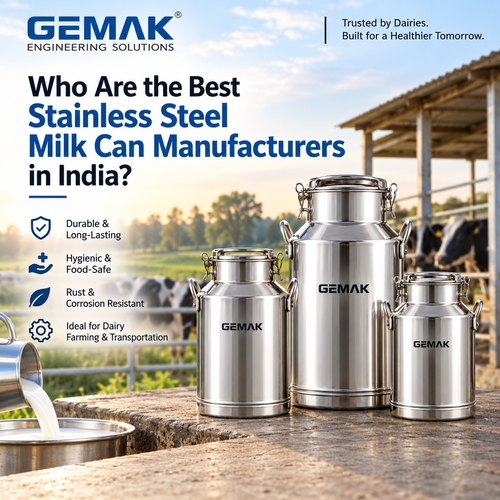
Milk collection is an important part of the dairy business. From small dairy farms to milk collection centres, milk needs to be collected and moved in containers that are strong, clean, and easy to handle.
This is why a stainless steel milk can is widely used in dairy operations. It is made for regular use, repeated cleaning, lifting, and transportation. But with many manufacturers and suppliers available in India, how do you choose the right one?
The answer is not simply the lowest price. You should also consider material quality, manufacturing process, capacity, welding, handles, surface finish, and overall construction.
What Is a Stainless Steel Milk Can?
A stainless steel milk can is a reusable container used to collect, store, and transport milk. Dairy farmers, milk collection centres, cooperatives, and milk processing businesses commonly use these cans.
A quality SS milk can needs to be strong enough for everyday handling while remaining easy to clean. Stainless steel is popular because it resists corrosion and withstands regular washing.
The manufacturing process is also important. A properly manufactured can should have a strong body, secure lid, reliable handles, and a smooth inner surface.
Why Is Stainless Steel Used for Milk Cans?
Think about a milk collection centre where cans are lifted, filled, emptied, washed, and transported every day. The container has to handle this routine without becoming difficult to use.
A good stainless steel milk can provides several practical benefits:
- Good corrosion resistance: It can withstand moisture and regular cleaning.
- Easy to clean: Smooth surfaces make removing milk residue easier.
- Durable construction: A properly manufactured can can handle frequent use.
- Reusable: It can be used repeatedly instead of being discarded after one use.
- Suitable for dairy handling: Stainless steel is commonly used in food and dairy equipment.
What Makes the Best Stainless Steel Milk Can?
When buying the best stainless steel milk can, look beyond its appearance.
The material used is one of the first things to check. According to the product information provided by Gemak, its milk cans are manufactured using 304-grade stainless steel prime material. The company states that this material provides high corrosion resistance. It also specifies deep drawing and spinning technology for manufacturing the cans. The product specifications also mention circumferentially welded lids, bent and riveted handles, and polished cans and lids. The stated mirror-bright finish is intended to support hygiene and easier cleaning.
These are important points buyers can compare when evaluating different manufacturers.
What Sizes of SS Milk Can Are Available?
Different dairy businesses have different milk-handling requirements. A small dairy farmer may need a smaller container, while a milk collection centre may require several larger cans.
The Gemak product range lists 5, 10, 20, 25, 30, 40, and 50-litre capacities. The product specifications also provide capacity tolerances for each size.
Choosing the correct capacity is important. Buyers should consider how much milk they collect each day, how they transport the milk, and how many cans their operation requires.
For example, a farmer with a smaller daily milk collection requirement may prefer a 10- or 20-litre can, while a larger collection centre may need 40- or 50-litre options.
Real-Life Example: A Village Milk Collection Centre
Imagine a village milk collection centre where 25 farmers bring milk every morning.
Each farmer arrives with milk collected from their dairy animals. The milk is weighed and checked before it is transferred for chilling and further processing.
Now imagine using cans with weak handles or rough internal surfaces. After months of daily use, the handles could become difficult to manage, while rough areas could make cleaning more time-consuming.
A properly designed stainless steel milk can can make this daily routine easier. Strong handles help with lifting, a smooth surface makes cleaning simpler, and durable construction is better suited to repeated transportation.
After collection, the milk may be transferred to a bulk milk cooler, where larger quantities are cooled before further processing or transportation.
This is why the milk can and bulk milk cooler have different but connected roles in the dairy supply chain.
Why the Manufacturing Process Matters
Two milk cans may look similar when placed side by side, but their quality can be different.
The manufacturing process affects the strength, shape, finish, and durability of the final product.
According to Gemak’s product information, its milk cans use deep drawing and spinning technology. The lids are described as circumferentially seam-welded, while the handles are bent, riveted, and spot-welded to the can body. Gemak SS Milk Cans manufacturing details
The product page also states that the bottom ring is made from 304-grade stainless steel and shrink-fitted to the can body.
For a buyer, these manufacturing details are more meaningful than simply comparing the quoted price.
How to Choose the Best Stainless Steel Milk Can Manufacturer in India
Before buying, ask these simple questions:
1. What stainless steel grade is used?
Ask the manufacturer for the exact material grade and product specifications.
2. How is the can manufactured?
Understand whether processes such as deep drawing, spinning, and welding are used.
3. Are the handles strong?
Handles are used repeatedly, so their construction and attachment should be checked.
4. Is the inside surface smooth?
A smooth finish can make regular cleaning easier.
5. What capacities are available?
Select the capacity according to your daily milk collection requirements.
6. Can the manufacturer supply in bulk?
For dairy cooperatives and milk collection networks, consistent supply can be as important as the product itself.
Frequently Asked Questions
Which stainless steel is best for milk cans?
304-grade stainless steel is commonly used for dairy equipment because of its corrosion resistance and durability. Buyers should still check the manufacturer’s actual material specifications before purchasing.
What sizes are available in stainless steel milk cans?
The available sizes depend on the manufacturer. Gemak’s listed range includes 5, 10, 20, 25, 30, 40, and 50-litre capacities.
What should I check before buying an SS milk can?
Check the stainless steel grade, capacity, body construction, welding, handles, lid design, surface finish, and manufacturer specifications.
Is a stainless steel milk can better than a plastic milk container?
For many dairy applications, stainless steel offers advantages such as durability, corrosion resistance, and ease of cleaning. The right choice depends on the intended application and applicable food-handling requirements.
What is the difference between a milk can and a bulk milk cooler?
A milk can is mainly used for collecting and transporting milk, while a bulk milk cooler is refrigeration equipment used to cool and hold larger quantities of milk.
Final Answer
The best stainless steel milk can manufacturers in India should offer more than an attractive price. Buyers should look for suitable stainless steel, strong construction, reliable handles, secure lids, smooth finishing, appropriate capacities, and consistent manufacturing quality. Gemak published specifications include 304-grade stainless steel, 5–50 litre capacity options, deep drawing and spinning technology, welded lids, reinforced handles, and polished finishing. Gemak SS Milk Cans
For dairy farmers, milk collection centres, and larger dairy businesses, selecting the right stainless steel milk can can make everyday milk collection, handling, cleaning, and transportation simpler and more reliable.