

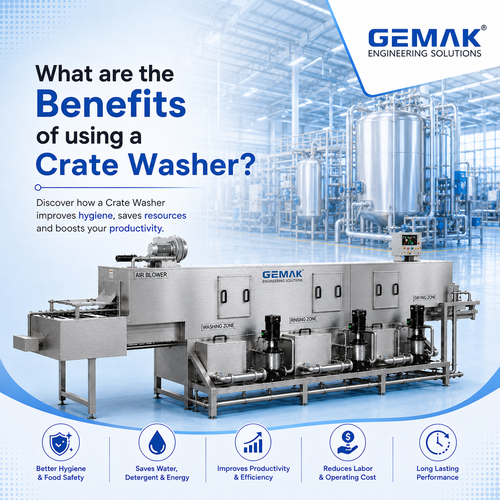
Reusable crates are essential in industries where products move repeatedly between processing, storage, transportation, and distribution. But with every cycle, crates can collect food residues, grease, dirt, dust, and other contaminants. When cleaning is handled manually, maintaining the same cleaning standard across a large volume of crates can become difficult.
This is where an industrial crate washer can make a significant difference. Automated crate washing systems are designed to provide controlled, repeatable cleaning while reducing dependence on manual washing. Depending on the machine configuration, washing systems can include multiple cleaning stages, water recirculation, adjustable washing programs, and high-pressure spray systems.
For businesses handling reusable crates at scale, the main benefits include better cleaning consistency, improved operational efficiency, reduced repetitive labor, better resource management, and easier scalability.
What is a crate washer?
A crate washer is an industrial washing machine designed to clean reusable crates, baskets, trays, bins, and similar containers. Instead of employees manually scrubbing or spraying each crate, containers can move through a controlled washing process using conveyors, spray systems, cleaning solutions, and rinsing stages.
A typical system may include pre-washing, main washing, rinsing, and optional drying or sanitizing stages. The exact configuration depends on the type of crate, contamination, required throughput, and hygiene requirements.
For example, Gemak Alfa Genesis crate washer range includes configurations for dairy and other applications, with features such as 360-degree cleaning coverage, water recirculation, PLC-based control, and different washing configurations.
What are the benefits of using a crate washer?
1. Faster and more efficient cleaning
Manual crate washing becomes increasingly time-consuming when hundreds or thousands of containers need to be cleaned every day. An automated system creates a more organized washing flow, allowing crates to move through predefined cleaning stages.
This can help reduce bottlenecks between production and packaging areas and provide a more predictable crate turnaround process.
2. More consistent cleaning results
One of the biggest challenges with manual washing is variation. Different operators may apply different amounts of pressure, cleaning time, or attention to difficult-to-reach areas.
An automated washing system can use defined washing parameters and repeatable cycles. This makes the cleaning process more consistent from one crate to the next.
3. Better hygiene control
Reusable crates can come into contact with food products, raw materials, packaging areas, or transportation surfaces. Proper cleaning is therefore an important part of an overall hygiene program.
A crate washer can provide controlled washing and rinsing stages designed around the type of residue being removed. However, the machine itself should not be treated as a guarantee of sterilization or complete pathogen elimination. Effective hygiene also depends on appropriate cleaning chemistry, temperature, contact time, maintenance, and the facility’s wider sanitation procedures.
4. Reduced repetitive manual labor
Crate washing can involve repetitive lifting, moving, spraying, and scrubbing. Automating much of this process can reduce the amount of repetitive cleaning work employees need to perform.
The objective is not necessarily to remove people from the process completely. Instead, operators can supervise loading, machine operation, inspection, and unloading while the washing system performs the repetitive cleaning cycle.
5. Better water and resource management
Industrial washing systems can be designed with features such as water recirculation, filtration, controlled spraying, and optimized washing stages. These features can help businesses manage water and cleaning chemicals more efficiently, depending on machine design and operating conditions. Gemak, for example, lists water recirculation as part of its Alfa Genesis crate washer solution.
Actual savings will depend on factors such as the existing manual process, crate volume, water quality, cleaning method, and machine configuration.
6. Easier scaling as production grows
A manual cleaning process that works for a small operation may become a serious bottleneck as production increases.
For example, imagine a food-processing facility that starts with a few hundred reusable crates but gradually increases its daily production. The number of crates requiring cleaning also rises. An automated washing line can provide a more scalable approach because the cleaning process is designed around defined throughput requirements rather than relying entirely on additional manual effort.
7. Easier integration into production workflows
Modern industrial washing equipment can be configured around existing production layouts. Depending on requirements, businesses can consider conveyor arrangements, multiple washing tracks, filtration, heating, drying, and control systems.
Gemak published crate washer information, for example, describing single- and double-track options and configurable washing systems for different operational requirements.
Practical examples of using a crate washer
Example 1: Dairy processing
A dairy facility may repeatedly use plastic crates for handling milk-related products or packaging materials. Continuous reuse means the crates need a dependable cleaning process before entering another production cycle. An automated washer can provide a repeatable cleaning workflow.
Example 2: Meat and poultry processing
Crates used in meat and poultry environments can encounter protein residues, grease, and other difficult contamination. In such applications, the washing system needs to be selected according to the contamination level and required hygiene process.
How does a crate washer work?
Although machine designs vary, an industrial washing process commonly follows several stages:
- Loading: Crates are positioned onto the conveyor or feeding system.
- Pre-washing: Loose dirt and residues are removed.
- Main washing: Water, mechanical spray action, and, where required, cleaning chemistry remove remaining contamination.
- Rinsing: Remaining cleaning solution and loosened residues are removed.
- Optional drying or sanitizing: Depending on the application, additional stages may be included.
- Inspection and unloading: Clean crates are checked and returned to production or storage.
Factors such as water temperature, spray pressure, nozzle arrangement, cleaning chemistry, contact time, and conveyor speed can influence cleaning performance.
Which industries can benefit from a crate washer?
Crate washing systems can be useful in operations that regularly reuse containers, including:
- Dairy and milk processing
- Meat and poultry processing
- Seafood processing
- Fruit and vegetable processing
- Food and beverage manufacturing
- Bakeries and confectionery operations
- Agriculture
- Logistics and distribution
- Manufacturing facilities using reusable containers
The right machine depends on the crate material, dimensions, contamination type, required capacity, available utilities, and production-line layout.
Is a crate washer better than manual crate cleaning?
| Factor | Manual Cleaning | Automated Crate Washing |
| Cleaning speed | Depends heavily on workforce | Designed for repeatable throughput |
| Consistency | Can vary between operators | Controlled washing cycle |
| Labor requirement | Higher manual involvement | Lower repetitive cleaning workload |
| Hygiene control | Depends on cleaning practice | Standardized process parameters |
| Scalability | Requires additional labor as volume grows | Can be configured for higher throughput |
| Repeatability | Operator-dependent | Machine-controlled |
| Initial investment | Generally lower | Higher equipment investment |
Automated washing is not automatically the right choice for every business. A small operation with limited crate volume may find manual cleaning practical. For high-volume operations, however, automation can become more attractive when labor, consistency, hygiene, and throughput are considered together.
What should businesses consider before choosing a crate washer?
Before purchasing an industrial washing system, businesses should evaluate:
- Crate dimensions and material
- Number of crates washed per hour
- Type and severity of contamination
- Required cleaning stages
- Water and energy availability
- Cleaning chemical requirements
- Available floor space
- Conveyor configuration
- Maintenance accessibility
- Filtration and wastewater management
- Drying requirements
- Integration with existing production equipment
- Future production growth
The goal should be to select a system that fits the complete cleaning workflow rather than choosing equipment based only on maximum washing capacity.
Frequently Asked Questions About Crate Washers
What is a crate washer used for?
A crate washer is used to automatically clean reusable crates, trays, bins, baskets, and similar containers. It is particularly useful in industries where containers are repeatedly used and need consistent cleaning before returning to production, storage, or transportation.
What are the main benefits of using a crate washer?
The main benefits include more consistent cleaning, faster processing, reduced repetitive manual work, improved workflow control, and better resource management. The exact benefits depend on the machine configuration and the facility’s existing cleaning process.
Can a crate washer improve hygiene?
Yes, an appropriately configured washing system can support a facility’s hygiene process by providing controlled and repeatable cleaning. However, hygiene performance also depends on cleaning chemicals, temperature, contact time, maintenance, and the facility’s overall sanitation procedures.
Is a crate washer suitable for food processing?
Yes. Crate washers are commonly used in food-related operations where reusable containers require regular cleaning. The equipment should be selected according to the food application, contamination type, crate design, hygiene requirements, and production volume.
Does a crate washer save labor?
An automated washing system can reduce the amount of repetitive manual washing, spraying, lifting, and scrubbing required. Operators can instead focus on machine supervision, material handling, inspection, and other production activities.
How do I choose the right crate washer?
Consider crate dimensions, contamination type, required throughput, washing stages, water and energy availability, floor space, maintenance requirements, and integration with your existing production line. A machine should be selected around the actual cleaning process rather than capacity alone.
Conclusion
For businesses that depend on reusable containers, crate cleaning is more than a routine task. It can affect hygiene, workflow efficiency, labor requirements, and the speed at which crates return to production.
A well-selected crate washer can make the cleaning process more consistent and scalable while reducing dependence on repetitive manual washing. The right solution will depend on crate design, production volume, contamination level, facility layout, and cleaning requirements. By evaluating these factors before investing, businesses can choose an industrial washing system that supports both current operations and future growth.