

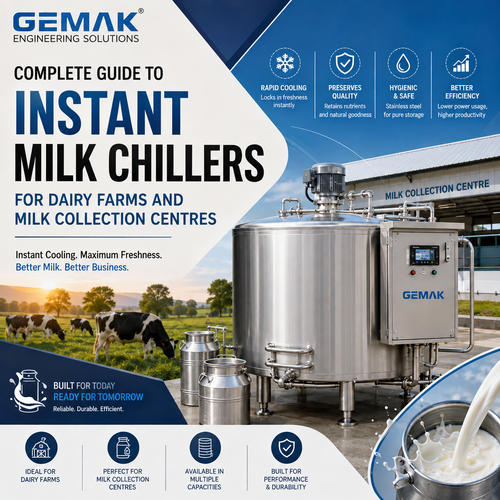
Fresh milk begins losing its quality the moment it leaves the cow if it is not cooled quickly. In many dairy farms and milk collection centres, delayed cooling results in bacterial growth, reduced shelf life, and financial losses. As dairy production continues to modernize, maintaining the freshness of milk has become a top priority for farmers and processors alike.
This is where Instant Milk Chillers play a vital role. These systems rapidly reduce the temperature of freshly collected milk, helping preserve its nutritional value, taste, and quality before it reaches processing facilities. Whether you operate a village milk collection centre or a large commercial dairy, investing in the right cooling solution can significantly improve efficiency and profitability.
Manufacturers like Gemak offer advanced dairy processing solutions designed to meet the growing demands of modern dairy businesses while maintaining high quality standards.
What are Instant Milk Chillers?
Instant Milk Chillers are specialized dairy cooling systems designed to reduce the temperature of freshly collected milk within minutes after milking. Instead of allowing milk to remain at ambient temperature, these systems immediately cool it to around 4°C, slowing bacterial growth and preserving freshness.
The cooling process uses advanced heat exchange technology where warm milk passes through chilled plates or cooling surfaces. Heat is removed rapidly, ensuring the milk reaches safe storage temperatures almost instantly.
For example, a dairy farmer collecting milk from several villages can cool the milk immediately before transportation, preventing spoilage even during long-distance travel.
Why Milk Needs Immediate Cooling
Fresh milk naturally contains nutrients that make it an ideal environment for bacterial multiplication. Without rapid cooling, microorganisms begin multiplying quickly, affecting taste, odor, and overall quality.
Immediate cooling helps to:
- Preserve nutritional value
- Maintain natural flavor
- Reduce bacterial activity
- Extend storage life
- Improve processing efficiency
- Minimize milk rejection at dairy plants
Food safety authorities recommend that raw milk should be cooled as soon as possible after milking to maintain its quality throughout the supply chain.
How Instant Milk Chillers Work
The working process of Instant Milk Chillers is straightforward yet highly efficient.
Step 1: Milk Collection
Fresh milk is collected directly from dairy farms or milk collection centres.
Step 2: Heat Exchange
Milk passes through a specially designed cooling chamber where heat is transferred to chilled water or refrigerant.
Step 3: Rapid Cooling
The milk temperature drops rapidly to approximately 4°C, preventing bacterial multiplication.
Step 4: Storage
The cooled milk is transferred into a Milk Storage Tank for safe storage before transportation.
Step 5: Continuous Monitoring
Modern systems continuously monitor temperature using digital controllers, ensuring consistent cooling performance.
Benefits of Instant Milk Chillers
Installing Instant Milk Chillers offers several operational and financial advantages.
- Preserves milk freshness
- Reduces bacterial contamination
- Improves milk quality
- Extends shelf life
- Reduces spoilage losses
- Increases farmer profitability
- Supports better transportation
- Enhances dairy processing efficiency
- Saves energy through optimized cooling systems
- Ensures compliance with dairy quality standards
These benefits make rapid cooling one of the most important investments for dairy businesses.
Applications of Instant Milk Chillers
Instant cooling technology is widely used across the dairy industry.
Common applications include:
- Dairy Farms
- Milk Collection Centres
- Dairy Cooperatives
- Commercial Dairy Farms
- Milk Procurement Centres
- Dairy Processing Plants
- Rural Chilling Centres
- Milk Transportation Networks
They are also integrated with Bulk Milk Cooler systems for larger-scale milk storage and handling.
Features to Consider Before Buying
Selecting the right Instant Milk Chiller requires evaluating both current and future production requirements.
Important features include:
Cooling Capacity
Choose a system that matches your daily milk collection volume.
Stainless Steel Construction
Food-grade stainless steel improves hygiene and equipment durability.
Automation
Automated temperature control reduces manual intervention.
Energy Efficiency
Energy-efficient refrigeration lowers operating costs over time.
Easy Cleaning
Look for equipment with clean-in-place (CIP) compatibility for better hygiene.
Reliable Service Support
Choose manufacturers offering dependable after-sales service and spare parts.
Digital Monitoring
Real-time monitoring improves operational accuracy and product safety.
Instant Milk Chillers vs Conventional Milk Cooling
| Feature | Instant Milk Chillers | Conventional Cooling |
| Cooling Speed | Immediate | Slow |
| Milk Quality | Excellent | Moderate |
| Bacterial Growth | Significantly Reduced | Higher Risk |
| Shelf Life | Longer | Shorter |
| Energy Efficiency | High | Moderate |
| Operational Cost | Lower Long-Term | Higher Due to Losses |
| Milk Safety | Better | Less Consistent |
Maintenance Tips
Proper maintenance ensures reliable operation and extends equipment life.
Follow these best practices:
- Clean the system daily after milk collection.
- Inspect compressors regularly.
- Monitor temperature sensors.
- Replace worn seals promptly.
- Check refrigerant levels periodically.
- Schedule preventive servicing.
- Maintain clean water supply for cooling systems.
- Keep electrical components dry and protected.
Routine maintenance minimizes downtime and protects milk quality.
Why Dairy Businesses Trust Gemak
Choosing reliable equipment is just as important as selecting the right technology.
Gemak has built a reputation for delivering dependable dairy processing solutions designed for efficiency, durability, and hygiene. Its engineering expertise supports dairy farms, milk collection centres, and processing facilities with equipment that meets modern operational requirements.
From Dairy Processing Equipment to integrated processing systems, Gemak focuses on quality manufacturing and practical solutions that help businesses maintain high standards throughout the milk handling process.
Frequently Asked Questions
What are Instant Milk Chillers?
Instant Milk Chillers are rapid cooling systems that quickly reduce the temperature of freshly collected milk to preserve quality, freshness, and nutritional value while minimizing bacterial growth.
Why is instant milk cooling important?
Immediate cooling slows bacterial multiplication, maintains milk quality, increases shelf life, and reduces spoilage during transportation and storage.
What temperature should milk be cooled to?
Fresh milk should generally be cooled to approximately 4°C soon after milking to maintain its quality before processing.
How do Instant Milk Chillers improve milk quality?
Rapid cooling preserves proteins, fats, flavor, and freshness while preventing bacterial growth that can lead to spoilage.
Are Instant Milk Chillers energy efficient?
Modern Instant Milk Chillers are designed with energy-efficient refrigeration systems, reducing electricity consumption while delivering consistent cooling performance.
Which industries use Instant Milk Chillers?
They are commonly used in dairy farms, milk collection centres, cooperatives, commercial dairies, and milk processing facilities.
How often should milk chillers be maintained?
Routine cleaning should be performed daily, while preventive maintenance and professional servicing should be scheduled regularly according to the manufacturer’s recommendations.
What is the difference between an Instant Milk Chiller and a Bulk Milk Cooler?
An Instant Milk Chiller rapidly cools freshly collected milk immediately after collection, while a Bulk Milk Cooler primarily stores already cooled milk at a consistent temperature before transportation or processing.
Conclusion
Maintaining milk quality begins immediately after milking. Investing in Instant Milk Chillers enables dairy farms and milk collection centres to preserve freshness, reduce spoilage, improve transportation efficiency, and increase profitability.
As dairy operations continue to grow, rapid cooling technology has become an essential part of modern milk handling. Combined with equipment such as Milk Pasteurizer, Homogenizer, Cream Separator, Milk Processing Plant, Milk Storage Tank, and Paneer Plant, an efficient cooling system strengthens the entire dairy processing chain.