

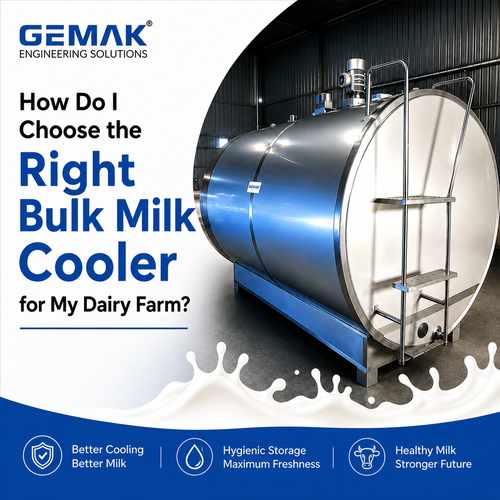
A Complete Buyer’s Guide for Indian Dairy Farmers, Milk Collection Centers, and Dairy Cooperatives
Quick Answer
Choosing the right Bulk Milk Cooler (BMC) depends on your daily milk production, future expansion plans, cooling technology requirements, electricity availability, and milk collection frequency. Most dairy experts recommend selecting a cooler with 15–30% additional capacity beyond current production to support future growth while ensuring milk is rapidly cooled to 4°C for maximum quality preservation.
Why Choosing the Right Bulk Milk Cooler Matters
India is the world’s largest milk-producing country, and maintaining milk quality from farm to processing plant is critical. Raw milk begins losing quality immediately after milking due to bacterial growth. Without proper cooling, milk quality can deteriorate rapidly, leading to:
- Reduced shelf life
- Lower procurement prices
- Increased bacterial contamination
- Higher rejection rates by dairies
- Financial losses for farmers
A Bulk Milk Cooler helps maintain milk at approximately 4°C, preserving freshness and quality until transportation or processing.
According to dairy industry best practices, rapid cooling significantly slows bacterial growth and helps maintain milk composition, taste, and nutritional value.
Understanding Bulk Milk Coolers
A Bulk Milk Cooler (BMC) is a refrigerated stainless-steel storage tank designed to cool and store raw milk immediately after milking.
Its primary functions include:
✓ Rapid milk cooling
✓ Temperature maintenance at 4°C
✓ Hygienic storage
✓ Quality preservation
✓ Reduced spoilage losses
Step 1: Calculate Your Daily Milk Production
The most important factor when selecting a BMC is your current and future milk production.
Example Capacity Calculation
| Number of Animals | Average Milk Yield | Total Daily Production |
| 50 Cows | 20 Litres | 1,000 Litres |
| 100 Cows | 20 Litres | 2,000 Litres |
| 200 Cows | 18 Litres | 3,600 Litres |
Expert Recommendation
Choose a BMC with 50% additional capacity beyond current production.
For example:
- Current production: 2,000 litres/day
- Recommended BMC size: 4000 litres
This prevents costly upgrades as your dairy farm expands.
Step 2: Choose the Right Capacity
Bulk Milk Coolers are available in various capacities:
- 500 Litres
- 1,000 Litres
- 2,000 Litres
- 3,000 Litres
- 5,000 Litres
Capacity Selection Table
| Daily Milk Collection | Recommended BMC Capacity |
| 500–100 Litres | 1,000–2,000 Litres |
| 1000–2,000 Litres | 2,000–4,000 Litres |
| 3,000–4,000 Litres | 5,000 Litres |
| 5,000+ Litres | 5 KL and Above |
Step 3: Choose Between DX and IBT Cooling Systems
One of the most common questions asked by dairy farmers is:
Which is Better: Direct Expansion (DX) or Ice Bank Tank (IBT)?
Direct Expansion (DX) Milk Cooling System
In DX systems, refrigerant directly cools milk through evaporator plates.
Advantages
- Lower initial investment
- Faster cooling for smaller volumes
- Easier installation
- Lower maintenance requirements
Best For
- Small dairy farms
- Medium-sized dairy farms
- Areas with reliable electricity supply
Ice Bank Tank (IBT) Milk Cooling System
IBT systems store cooling energy in ice and release it when required.
Advantages
- Handles larger milk volumes
- Better performance during peak collection
- More energy-efficient in many applications
- Reliable in areas with fluctuating power supply
Best For
- Dairy cooperatives
- Milk collection centers
- Large commercial dairy farms
Step 4: Evaluate Cooling Performance
Cooling speed directly impacts milk quality.
Ideal Cooling Requirement
Milk should be cooled from approximately 35°C to 4°C as quickly as possible after milking.
Ask suppliers:
- What is the cooling time?
- How quickly does the system achieve 4°C?
- Does performance remain consistent during summer?
This is particularly important in India, where summer temperatures often exceed 40°C in many dairy-producing regions.
Indian Dairy Conditions Require Special Attention
Indian dairy farms face unique challenges:
- High ambient temperatures
- Rural power fluctuations
- Long milk transportation distances
- Seasonal production changes
For this reason, farmers should prioritize equipment specifically designed for Indian climatic conditions.
Many established dairy equipment manufacturers, including Gemak Engineering Solutions, develop cooling systems considering the operational realities of Indian dairy farms and milk collection centers.
Step 5: Check Stainless Steel Quality
Milk is highly sensitive to contamination.
Choose a BMC constructed with:
- Food-grade stainless steel
- Corrosion-resistant materials
- Smooth internal surfaces
- Hygienic welding
- Easy-clean design
A well-constructed stainless steel tank improves hygiene and extends equipment life.
Step 6: Evaluate Energy Efficiency
Electricity costs represent a significant portion of dairy operating expenses.
Key Factors
- Compressor efficiency
- Refrigeration system design
- Insulation thickness
- Agitator efficiency
- Digital control systems
A slightly higher initial investment in an energy-efficient BMC often results in substantial savings over its operational lifespan.
Step 7: Consider Cleaning and Hygiene Features
Milk quality depends heavily on sanitation.
Look for:
- Easy-access cleaning design
- Smooth internal tank surfaces
- CIP (Clean-In-Place) compatibility
- Hygienic agitators
- Efficient drainage systems
Poor cleaning can increase bacterial counts and reduce milk quality despite effective cooling.
Step 8: Smart Monitoring and Automation
Modern dairy operations increasingly use automation to improve efficiency.
Useful features include:
- Digital temperature displays
- Automatic temperature control
- Alarm systems
- Data logging
- Online monitoring
- Remote diagnostics
These features help prevent milk spoilage and reduce operational risks.
Step 9: Evaluate Service and Spare Parts Support
Many farmers focus only on equipment price and overlook after-sales service.
Before purchasing, ask:
- Is service available in my region?
- What is the response time?
- Are spare parts readily available?
- What warranty is included?
- Is preventive maintenance offered?
Reliable service support can significantly reduce downtime and long-term operating costs.
Step 10: Plan for Future Expansion
Many dairy farms increase production within 3–5 years.
Before buying, consider:
- Additional cattle purchases
- Expansion of milk collection activities
- New dairy processing operations
A slightly larger BMC today can eliminate expensive replacement costs tomorrow.
Common Mistakes Dairy Farmers Should Avoid
Buying Only Based on Price
The cheapest equipment may have higher maintenance costs.
Choosing Exact Current Capacity
Future growth should always be considered.
Ignoring Electricity Consumption
Operating costs continue for years after purchase.
Overlooking Service Support
Equipment downtime can lead to milk losses.
Purchasing Non-Scalable Systems
Expansion should be part of every purchasing decision.
Internal Resources You Should Also Explore
To better understand milk cooling and dairy infrastructure, consider learning about:
- Bulk Milk Cooler Systems
- Instant Milk Chillers
- Milk Storage Tanks
- Dairy Processing Equipment
- Milk Collection Centre Solutions
- DX Milk Cooling Systems
- IBT Milk Cooling Systems
- Online Monitoring Systems for Dairy Farms
These technologies work together to improve milk quality and operational efficiency.
Frequently Asked Questions
What size bulk milk cooler do I need?
The ideal size depends on daily milk production, collection frequency, and future expansion plans. Most farms should keep an additional 15–30% storage margin.
What temperature should milk be stored at?
Milk should generally be maintained at approximately 4°C to preserve freshness and reduce bacterial growth.
Which is better: DX or IBT?
DX systems are often suitable for smaller and medium-sized farms, while IBT systems are commonly preferred for larger milk collection operations.
How much electricity does a bulk milk cooler consume?
Electricity consumption depends on capacity, refrigeration design, ambient temperature, and operating conditions.
How often should a bulk milk cooler be cleaned?
Cleaning should be performed after every milk collection cycle according to established dairy hygiene practices.
Can a bulk milk cooler work in rural areas?
Yes. Many modern systems are designed to operate efficiently in rural environments where power fluctuations may occur.
Conclusion
Selecting the right Bulk Milk Cooler is a long-term investment in milk quality, profitability, and farm growth.
Before making a purchase, evaluate:
✓ Daily milk production
✓ Future expansion plans
✓ DX or IBT technology
✓ Cooling performance
✓ Energy efficiency
✓ Hygiene features
✓ Service support
✓ Smart monitoring capabilities
For Indian dairy farmers, choosing a reliable and scalable cooling solution is often more important than selecting the lowest-cost option. Many dairy businesses compare technical specifications, energy performance, and service capabilities from experienced manufacturers such as Gemak when evaluating long-term milk cooling investments.
The right Bulk Milk Cooler not only protects milk quality but also supports the sustainable growth of your dairy operation for years to come.