

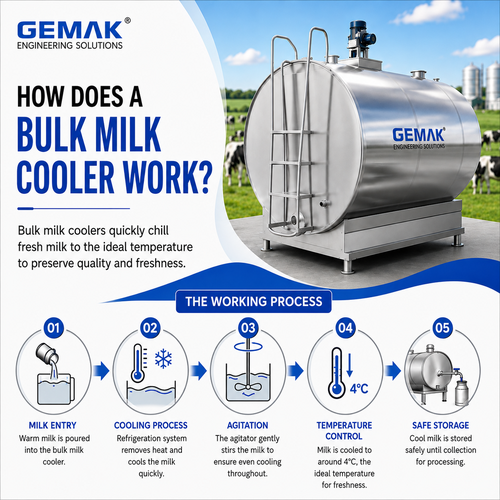
A bulk milk cooler is a dairy storage system designed to quickly cool freshly collected milk and keep it chilled until collection or processing. It uses a refrigeration system, an insulated stainless-steel tank, an agitator, and temperature controls to remove heat efficiently while helping maintain consistent milk quality.
What is a bulk milk cooler?
Freshly milked milk contains natural heat and can become a suitable environment for microorganisms if it remains warm for too long. A bulk milk cooler addresses this problem by transferring heat from the milk to a refrigeration system.
Unlike a simple storage container, a bulk milk cooler actively cools and stores milk under controlled conditions. These systems are commonly used on dairy farms, milk collection centers, and other facilities where milk from multiple milking sessions needs to be stored before transportation.
How does a bulk milk cooler work?
The working process is relatively straightforward, but several components work together to achieve effective cooling.
1. Milk enters the tank
After milking, fresh milk is transferred into the insulated stainless-steel tank. The amount of milk depends on the cooler’s capacity.
2. Heat begins to leave the milk
The refrigeration system starts removing heat from the milk through the cooling surface or evaporator associated with the tank. The heat is transferred away from the milk and ultimately released through the refrigeration system.
3. The agitator mixes the milk
An internal agitator gently mixes the milk at controlled intervals. This helps distribute the temperature more evenly throughout the tank and prevents warmer and cooler layers from remaining separated.
4. The refrigeration system reaches the required temperature
The compressor, condenser, expansion components, and evaporator work together as a refrigeration cycle. As heat is removed, the milk temperature gradually falls toward the required chilled range.
5. Temperature is maintained
Once the desired temperature is reached, the control system helps regulate refrigeration operation. The insulated tank reduces heat transfer from the surrounding environment, allowing the milk to remain chilled until collection or processing.
In simple terms:
Fresh milk → insulated tank → heat removal → agitation → temperature control → chilled milk ready for collection
What are the main components of a bulk milk cooler?
A typical cooler contains several important components, each with a specific function.
| Component | Main function |
| Stainless-steel tank | Holds the milk hygienically |
| Insulation | Reduces heat transfer from outside |
| Refrigeration compressor | Drives the refrigeration cycle |
| Condenser | Releases extracted heat |
| Evaporator/cooling surface | Transfers heat away from the milk |
| Agitator | Helps maintain more uniform milk temperature |
| Temperature sensor | Measures milk temperature |
| Controller | Regulates cooling operation |
| Outlet/drain | Allows controlled milk discharge |
The combination of these components allows the system to cool and store milk under controlled conditions.
Why is milk cooling important?
Cooling milk promptly after milking is an important part of maintaining milk quality. Warm milk can support faster microbial growth, which can negatively affect quality if temperature control is delayed.
Rapid cooling helps slow this microbial activity and supports better handling between milking and collection. It also provides dairy operators with greater control over milk storage before the product moves to a processing facility.
However, cooling is only one part of good milk handling. Clean equipment, hygienic milking practices, proper tank cleaning, and appropriate transportation conditions are also essential.
How quickly should milk be cooled?
Milk should be cooled promptly after milking, but the exact cooling performance depends on several factors. These include the quantity of milk entering the tank, starting milk temperature, cooler capacity, refrigeration performance, ambient temperature, and whether milk is added from one or multiple milking sessions.
The applicable temperature target can also depend on local regulations, dairy collection requirements, and the equipment manufacturer’s specifications. For this reason, dairy operators should follow the operating instructions and applicable milk-handling standards rather than relying on a single temperature figure for every situation.
Example: How does a bulk milk cooler work on a dairy farm?
Consider a dairy farm that collects milk during a morning milking session.
The freshly collected milk is transferred into the cooling tank. Because the milk is initially warm, the refrigeration system begins removing heat as soon as the cooling cycle starts. The agitator periodically mixes the milk to support more uniform temperature distribution.
As the refrigeration system continues operating, the milk gradually reaches the required chilled condition. The controller then manages the cooling cycle to help maintain the temperature while the milk remains in storage.
When the milk collection vehicle arrives, the chilled milk can be transferred from the tank for transportation to the processing facility.
This example shows why cooler capacity needs to match the farm’s actual milk collection volume and operating schedule.
What are the benefits of using a bulk milk cooler?
A properly selected and maintained bulk milk cooler can provide several practical advantages:
- Faster heat removal: Fresh milk can be cooled soon after collection.
- Better temperature control: Sensors and controls help maintain the desired chilled condition.
- Improved storage management: Milk can remain in a controlled environment before collection.
- Hygienic handling: Stainless-steel construction supports appropriate dairy hygiene practices.
- Uniform cooling: Agitation helps reduce temperature differences within the tank.
- Better operational consistency: Automated refrigeration reduces dependence on manual cooling methods.
For dairy operations evaluating equipment, manufacturers such as Gemak can be considered alongside factors such as capacity, cooling performance, hygiene, energy efficiency, maintenance, and after-sales support.
What should you consider when choosing a bulk milk cooler?
Capacity should be one of the first considerations. The cooler should accommodate the expected milk volume without creating unnecessary cooling or storage limitations.
Other factors include refrigeration performance, tank insulation, agitator design, temperature monitoring, cleaning requirements, power consumption, construction quality, maintenance accessibility, and service availability.
The operating environment also matters. A cooler used in a warm climate may have different refrigeration requirements from one operating in a cooler environment.
Choosing equipment based only on tank capacity can therefore be misleading. The complete cooling system should match the farm’s milk volume, collection schedule, infrastructure, and long-term operating requirements.
Frequently Asked Questions
How does a bulk milk cooler cool milk?
A bulk milk cooler removes heat from freshly collected milk through a refrigeration system. The milk is held in an insulated tank while the cooling surface removes heat. An agitator helps distribute the milk more evenly, while temperature controls regulate the cooling process.
What temperature does a bulk milk cooler maintain?
The operating temperature depends on applicable dairy standards, collection requirements, equipment specifications, and the intended storage period. Dairy operators should follow the relevant local requirements and the manufacturer’s recommended operating conditions.
Why is milk cooled immediately after milking?
Fresh milk is warm and can support faster microbial growth when left at higher temperatures. Prompt cooling helps slow this activity and supports better milk quality during storage and transportation.
How long does a bulk milk cooler take to cool milk?
Cooling time varies according to milk volume, starting temperature, tank capacity, refrigeration capacity, ambient conditions, and system design. A cooler designed for a particular farm’s operating pattern can provide more predictable cooling performance.
What is the purpose of the agitator in a bulk milk cooler?
The agitator gently mixes the milk to help maintain a more uniform temperature throughout the tank. This supports consistent cooling and helps prevent significant temperature differences between different areas of the stored milk.
Conclusion
A bulk milk cooler combines refrigeration, controlled agitation, insulation, and temperature monitoring to rapidly remove heat from freshly collected milk and keep it chilled. Its effectiveness depends not only on tank capacity but also on refrigeration performance, hygiene, temperature control, and proper operation.
For dairy farms and milk collection facilities, selecting the right cooling system can make milk handling more controlled, consistent, and efficient from milking through collection and processing.